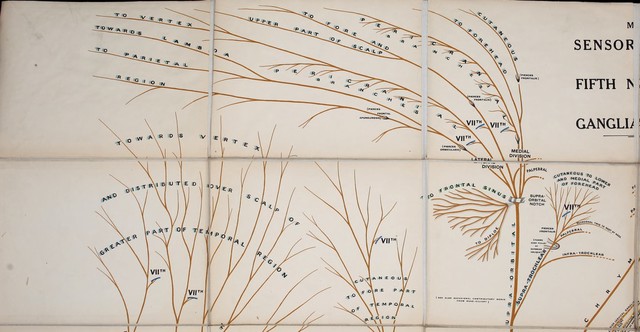
Map scheme of the sensory distribution of the fifth nerve (trigeminus) with its ganglia and connections [with text] / L. Hemington Pegler.
- Pegler, L. Hemington.
- Date:
- 1913
Licence: In copyright
Credit: Map scheme of the sensory distribution of the fifth nerve (trigeminus) with its ganglia and connections [with text] / L. Hemington Pegler. Source: Wellcome Collection.
Provider: This material has been provided by UCL Library Services. The original may be consulted at UCL (University College London)
28/46 page 18
![PHYSIOLOGICAL ANALYSES I. CILIARY GANGLION TABLE OF DISTRIBUTION AND FUNCTIONS OF THE LONG AND SHORT CILIARY NERVES 1. Trigeminal fibres in nasal root,! c r , , .,. , , , . and long ciliary nerves ... } Sensory t0 tunics of §lobe' Clhary ^ COrnea' and ins' 2. Sympathetic fibres from! Diiator nbres to pupil. cavernous plexus conveyed y , ri , i <■ , u , , r- , i . Vaso-dilator fibres to vessels of globe, by ophthalmic, and nasal root J & 3. Sympathetic fibres passing to! Motor fibres to Miiller's muscle (non-striated fibres of levator palpebrae). the globe from cavernous - w , • , cu , i r i u i j* .1 Vaso-constnctor fibres to vessels ot globe, plexus directly ......] ° 4. Fibres of third nerve passing] directly to the ciliary gan- V Motor fibres to sphincters of pupil and ciliary muscle, glion, but interrupted in it1 J II. ANALYSIS OF THE CONNECTIONS OF THE FIFTH NERVE WITH THE PARS INTERMEDIA (SENSORY PART OF THE FACIAL) Note.—The map shows that the pars intermedia gains access to the ophthalmic nerve through one connection only— viz., the loop of anastomosis between the lachrymal and zygomatic nerves, the fibres being conveyed by the great superficial petrosal to the spheno-palatine ganglion. The first division of the fifth is thus supplied through the second, the current ascending by the spheno-palatine nerves, and taking a reflected course to reach the maxillary nerve and its zygomatic branch. The third, or mandibular division is connected with the pars intermedia through the chorda tympani—first, by a filament from the chorda to the otic ganglion, and secondly, by direct fusion with the lingual. 1 The fibres in Nos. I, 2, and 3 are believed to pass uninterrupted through the ciliary ganglion.](https://iiif.wellcomecollection.org/image/b21274393_0028.jp2/full/800%2C/0/default.jpg)


 No text description is available for this image
 No text description is available for this image
 No text description is available for this image