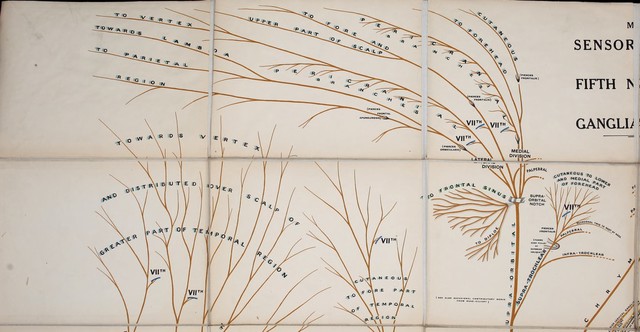
Map scheme of the sensory distribution of the fifth nerve (trigeminus) with its ganglia and connections [with text] / L. Hemington Pegler.
- Pegler, L. Hemington.
- Date:
- 1913
Licence: In copyright
Credit: Map scheme of the sensory distribution of the fifth nerve (trigeminus) with its ganglia and connections [with text] / L. Hemington Pegler. Source: Wellcome Collection.
Provider: This material has been provided by UCL Library Services. The original may be consulted at UCL (University College London)
29/46 page 19
![There is also the anastomotic ramus from the geniculate ganglion to the small superficial petrosal or to the tympanic plexus (according to how it is regarded), the former being the French, the latter the German view.1 These facts ma}' be restated as follows : Pars intermedia Through great superficial petrosal and | Vidian to spheno-palatine ganglion .. I Through chorda tympani, accompanying lingual ... Through chorda by way of long buccal ^ nerve to otic ganglion (?) ... ...j j To lachrymal gland. Secretory and vaso-dilator 1 To racemose nasal glands. [ To glands of soft palate. Gustatory fibres to anterior two-thirds of tongue. ( To submaxillary gland. - To sublingual gland. I To glands of floor of mouth. ? Secretory and vaso-dilator to glands of lining of cheek. Secretory and vaso-dilator fibres ... III. CONNECTIONS BETWEEN THE FIFTH NERVE AND THE GLOSSOPHARYNGEAL Note.—The chief communication is through the tympanic nerve. With the second division of the fifth the tympanic is connected through the caroticotympanic and small deep petrosal nerves, which, after uniting with the carotid plexus, convey fibres to the great deep petrosal, and thus reach the spheno- palatine ganglion ; or the small deep petrosal may join directly with one of the large petrosals (Quain, vol. iii., part ii., p. 39). A constant and important connection with the third division is formed by the continuation of the tympanic nerve as the small superficial petrosal to the otic ganglion. The path is here probably interrupted, and continued along two small filaments to the auriculo-temporal, whence the fibres reach their destination in the parotid gland. Glosso-pharyngeal I By tympanic, small deep petrosal,] With second division of fifth \ great deep petrosal and Vidian V Vaso-dilator and secretory fibres. [ to spheno-palatine ganglion ...J „7. , u. J J r£ru I By tympanic and small superficial Vaso-dilator and secretory fibres With third division ot filth - petrosal to auriculo-temporal - to parotid <*land \ through otic ganglion ...j 1 The fibres in this branch are said not to appear to be connected with the cells of the geniculate ganglion (Morris's ' Treatise,' edit iv](https://iiif.wellcomecollection.org/image/b21274393_0029.jp2/full/800%2C/0/default.jpg)


 No text description is available for this image
 No text description is available for this image
 No text description is available for this image