Notes on preventive medicine for medical officers, United States Navy / Department of the Navy, Bureau of Medicine and Surgery.
- Bureau of Medicine and Surgery
- Date:
- 1918
Licence: Public Domain Mark
Credit: Notes on preventive medicine for medical officers, United States Navy / Department of the Navy, Bureau of Medicine and Surgery. Source: Wellcome Collection.
1/12
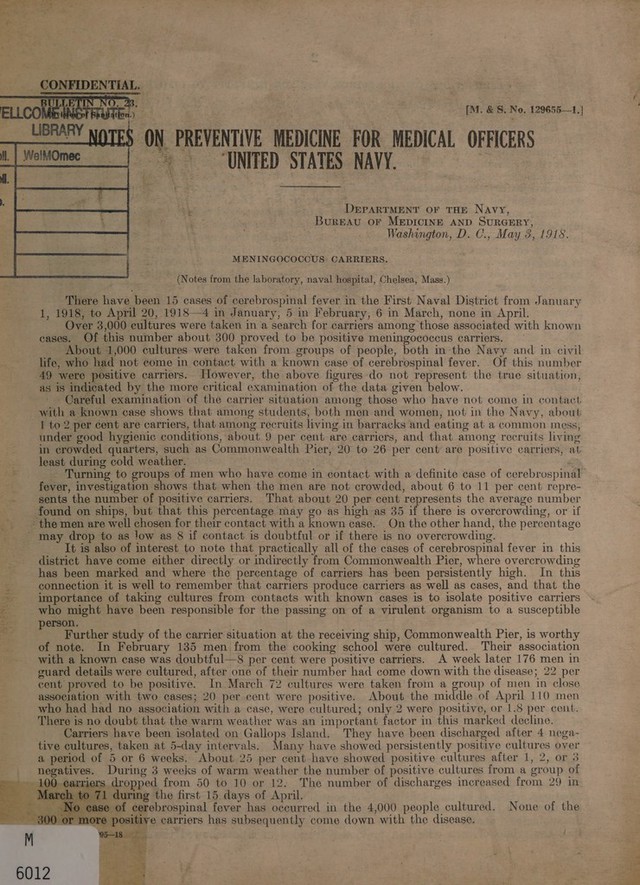
![[M. & S. No, 129655—1.] $ ON PREVENTIVE MEDICINE FOR MEDICAL OFFICERS UNITED STATES NAVY. = Mh + . - . DerarrMent or tHE Navy, - Bureau or MEDICINE AND SURGERY, | Washington, D. C., May 3, 1918. MENINGOCOCCUS: CARRIERS. (Notes from the laboratory, naval hospital, Chelsea, Mass.) There have been 15 cases of cerebrospinal fever in the First Naval District from January 1, 1918, to April 20, 1918—4 in January, 5 in February, 6 in March, none in April. Over 3,000 cultures were taken in a search for carriers among those associated with known cases. Of this number about 300 proved to be positive meningococcus carriers. — About 1,000 cultures were taken from groups of people, both m-the Navy and in civil life, who had not come in contact with a known case of cerebrospinal fever. Of this number 49 were positive carriers. However, the above figures do not represent the true situation, as is indicated by the more critical examination of the data given below. Careful examination of the carrier situation among those who have not come in contact with a known case shows that among students, both men and women, not in the Navy, about 1 to 2 per cent are carriers, that among recruits living in barracks and eating at a common mess, under good hygienic conditions, about 9 per cent are carriers, and that among recruits living in crowded quarters, such as Commonwealth Pier, 20 to 26 per cent are positive carriers, at least during cold weather. fever, investigation shows that when the men are not crowded, about 6 to 11 per cent repre- sents the number of positive carriers. That about 20 per cent represents the average number found on ships, but that this percentage may go as high as 35 if there is overcrowding, or if ~ the men are well chosen for their contact with a known case. On the other hand, the percentage ~ may drop to as low as 8 if contact is doubtful or if there is no overcrowding. It is also of interest to note that practically all of the cases of cerebrospinal fever in this district have come either directly or indirectly from Commonwealth Pier, where overcrowding has been marked and where the percentage of carriers has been persistently high. In this connection it is well to remember that carriers produce carriers as well as cases, and that the importance of taking cultures from contacts with known cases is to isolate positive carriers who might have been responsible for the passing on of a virulent organism to a susceptible : erson. ro Further study of the carrier situation at the receiving ship, Commonwealth Pier, is worthy | of note. In February 135 men from the cooking school were cultured. Their association with a known case was doubtful—8 per cent were positive carriers. A week later 176 men in guard details were cultured, after one of their number had come down with the disease; 22 per cent proved to be positive. In March 72 cultures were taken from a group of men in close association with two cases; 20 per cent were positive. About the middle of April 110 men who had had no association with a case, were cultured; only 2 were positive, or 1.8 per cent. There is no doubt that the warm weather was an important factor in this marked decline. Carriers have been isolated on Gallops Island. They have been discharged after 4 nega- tive cultures, taken at 5-day intervals. Many have showed persistently positive cultures over a period of 5 or 6 weeks. About 25 per cent have showed positive cultures after 1, 2, or 3 negatives. During 3 weeks of warm weather the number of positive cultures from a group of ~ 100 carriers dropped from 50 to 10 or 12. The number of discharges increased from 29 in _ March to 71 during the first 15 days of April. ease of cerebrospinal fever has occurred in the 4,000 people cultured. None of the _ 300 or more positive carriers has subsequently come down with the disease, M — : aah foe](https://iiif.wellcomecollection.org/image/b32183070_0001.jp2/full/800%2C/0/default.jpg)