The wonders of the universe : a record of things wonderful and marvelous in nature, science, and art / introduction by Charles Barnard.
- Date:
- [1885], ©1885
Licence: Public Domain Mark
Credit: The wonders of the universe : a record of things wonderful and marvelous in nature, science, and art / introduction by Charles Barnard. Source: Wellcome Collection.
147/448
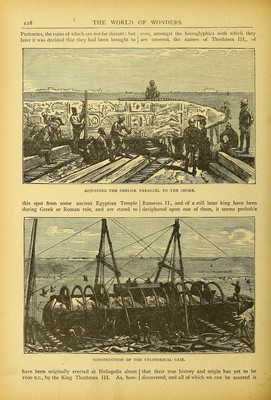
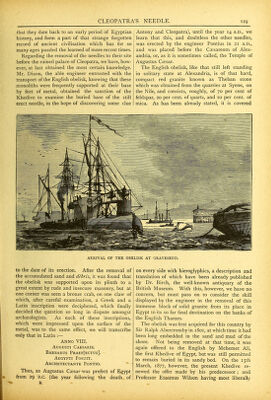
![that they date back to an early period of Egyptian history, and form a part of that strange forgotten record of ancient civilisation which has for so many ages puzzled the learned of more recent times. Regarding the removal of the needles to their site before the ruined palace of Cleopatra, we have, how- ever, at last obtained the most certain knowledge. Mr. Dixon, the able engineer entrusted with the transport of the English obelisk, knowing that these monoliths were frequently supported at their base by feet of metal, obtained the sanction of the Khedive to examine the buried base of the still erect needle, in the hope of discovering some clue Antony and Cleopatra), until the year 14 A.D., we learn that this, and doubtless the other needles, was erected by the engineer Pontius in 21 a.d., and was placed before the Csesareum of Alex- andria, or, as it is sometimes called, the Temple of Augustus Caesar. The English obelisk, like that still left standing in solitary state at Alexandria, is of that hard, compact red granite known as Theban stone which was obtained from the quarries at Syene, on the Nile, and consists, roughly, of 70 per cent of feldspar, 20 per cent, of quartz, and 10 per cent, of mica. As has been already stated, it is covered ARRIVAL OF THE OBELISK AT GRAVESEND. to the date of its erection. After the removal of the accumulated sand and debris, it was found that the obelisk was supported upon its plinth to a great extent by rude and insecure masonry, but at one corner was seen a bronze crab, on one claw of which, after careful examination, a Greek and a Latin inscription were deciphered, which finally decided the question so long in dispute amongst archaeologists. As each of these inscriptions, which were impressed upon the surface of the metal, was to the same effect, we will transcribe only that in Latin :— Anno VIII. August: Caesaris. Barbarus Praef[ectus]. Aegypti Posuit. Archetectante Pontio. * Thus, as Augustus Caesar'was prefect of Egypt from 29 B.C. (the year following the death of R on every side with hieroglyphics, a description and translation of which have been already published by Dr. Birch, the well-known antiquary of the British Museum. With this, however, we have no concern, but must pass on to consider the skill displayed by the engineer in the removal of this immense block of solid granite from its place in Egypt to its so far final destination on the banks of the English Thames. The obelisk was first acquired for this country by Sir Ralph Abercromby in 1801, at which time it had been long embedded in the sand and mud of the shore. Not being removed at that time, it was again offered to the English by Mehemet Ali, the first Khedive of Egypt, but was still permitted to remain buried in its sandy bed. On the 15th March, 1877, however, the present Khedive re- newed the offer made by his predecessor ; and Professor Erasmus Wilson having most liberally](https://iiif.wellcomecollection.org/image/b21498830_0147.jp2/full/800%2C/0/default.jpg)