English wayfaring life in the middle ages : (xivth century) / by J.J. Jusserand ... tr. from the French by Lucy Toulmin Smith.
- Jean Jules Jusserand
- Date:
- 1889
Licence: Public Domain Mark
Credit: English wayfaring life in the middle ages : (xivth century) / by J.J. Jusserand ... tr. from the French by Lucy Toulmin Smith. Source: Wellcome Collection.
160/462 (page 154)
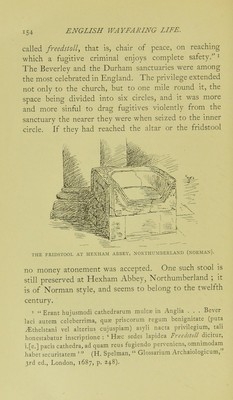
![called freedstoll, that is, chair of peace, on reaching which a fugitive criminal enjoys complété safety.” ^ The Beverley and the Durham sanctuaries were among the most celebrated in England. The privilège extended not only to the church, but to one mile round it, the space being divided into six circles, and it was more and more sinful to drag fugitives violently from the sanctuary the nearer they were when seized to the inner circle. If they had reached the altar or the fridstool THE FRIDSTOOL AT HEXHAM ABEEY, NORTHUMBERLAND (NORMAN). no money atonement was accepted. One such stool is still preserved at Hexham Abbey, Northumberland it is of Norman style, and seems to belong to the twelfth century. * “ Erant hujusmodi cathedrarum niultæ in Anglia . . . Bever laci autera celeberrima, quæ priscorum reguni benignitate (puta Æthelstani vcl alterius cujuspiam) asyli nacta privilegium, tali honestabatur inscriptionc : ‘ Hæc sedes lapidea Freedstoll dicitur, i.[c.] pacis cathedra, ad quam reus fugiendo perveniens, omnimodain habet securitatem ’ ” (H. Spelman, “ Glossarium Archaiologicum,” 3rd ed., London, 1687, p. 248).](https://iiif.wellcomecollection.org/image/b24857440_0160.jp2/full/800%2C/0/default.jpg)