A handbook of house sanitation : for the use of all persons seeking a healthy home ; a reprint of those portions of Mr. Bailey-Denton's lectures on sanitary engineering given before the school of military engineering, Chatham, which related to the "dwelling."
- John Bailey Denton
- Date:
- 1882
Licence: Public Domain Mark
Credit: A handbook of house sanitation : for the use of all persons seeking a healthy home ; a reprint of those portions of Mr. Bailey-Denton's lectures on sanitary engineering given before the school of military engineering, Chatham, which related to the "dwelling.". Source: Wellcome Collection.
Provider: This material has been provided by The University of Leeds Library. The original may be consulted at The University of Leeds Library.
91/254 (page 75)
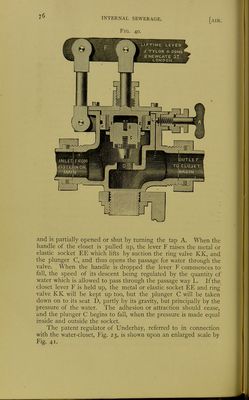
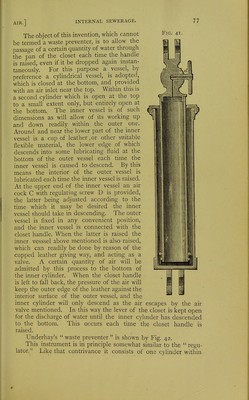
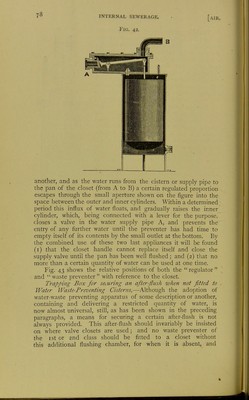
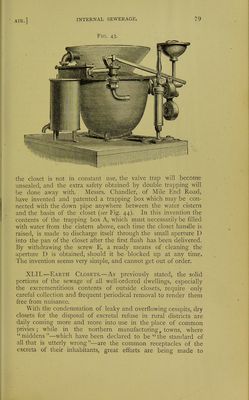
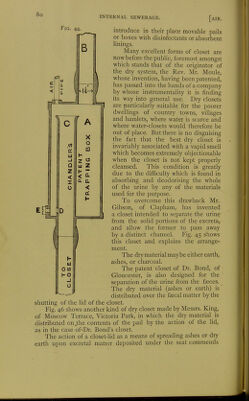
![cistern, the right hand compartment being the first to fill as ^^^Messts. Brazier, of the Blackfriars Road, and Mr. Purnell, of Westminster, have both invented syphon waste preventers, but the experience gained of these contrivances does not enable us to say more than that they each possess some of the elements of success^' In both examples, as in the case of Braithwaite's and Emanuel'V^ directly the syphon is brought into action, the water should be-, delivered and should continue to discharge with nearly equaf; force from the beginning to the end when a dribble at the last^ should be impossible. It should not matter whether thj^. handle is let go direcdy or held for a time, the required quantity of water should be discharged in either case and no more. Thus while waste is prevented an effectual flush to the closet is ensured, which, as one inventor points out, is a great advantage when the carelessness of servants is considered, who very often, after, emptying their slops down the closet, just give the handle a, slight pull and leave it. Waste Pj-eventers and Regulatorsfixed under the Seats of Closets. —Although many authorities on the subject consider that waste ■ of water is better prevented by the use of cisterns placed above ' die seat of the closet, and which discharge a fixed quantity each time they are acted upon, there are others who prefer those ]jlaced under the closet seat. They possess the following advantages :—(i) They naturally occupy less room in the closet itself; (2) Any number of closets can be supplied by one service pipe from the cistern above; (3) There is no interval between the raising of the handle and the inrush of water into the basin. The disadvantages are—(i) Less force is obtained in flushing out the basin, which should be a primary object; (2) The arrange- ment is not mechanically so durable ; and (3) There is not generally that thorough disconnection from the general water supply which should always be aimed at. Under this heading Fig. 40 represents on a large scale Messrs. Tylor's waste preventer, which may be safely and advan- tageously used where the supply of water is obtained from a cistern serving more than one closet, or where the supply cistern being placed over the closet, the outflow from it is not limited to a fixed quantity. Here C is a plunger fitted with a washer valve H at the bottom, and moving up and down in a metal or elastic socket EE, which forms a carrier, and which is fixed to the spindle connected with the lifting lever F. This valve is made, when preferred, with a flat elastic washer or diaphragm (instead of EE). KK is a ring valve for the purpose of controlling the descent of the metal or elastic socket EE. L is a passage way by which the water flows from under to above the ring valve KK,](https://iiif.wellcomecollection.org/image/b21508495_0091.jp2/full/800%2C/0/default.jpg)