Chemistry of organic bodies. Vegetables / By Thomas Thomson.
- Thomas Thomson
- Date:
- 1838
Licence: Public Domain Mark
Credit: Chemistry of organic bodies. Vegetables / By Thomas Thomson. Source: Wellcome Collection.
1075/1108 page 1051
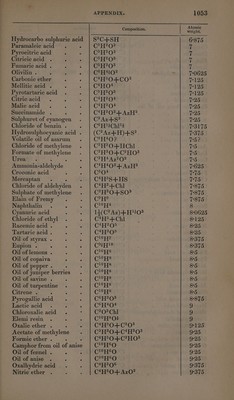
![TABLE III. Specific gravity = atomic weight X 11111 Specific gravity. Name of vapour. Atomic weight. é. By experiment.| By calculation. Oxygen 7 ate 3 Oe] 1s Bi ed eae Ge gt) TABLE IV. Specific gravity = atomic weight X 2°2222 Specific gravities. Names of vapours. Atomic weights, By ex haraukt By calculation. Phosphorus i F : Phi=33 4:465 4:4444 Arsenic 4 j ; Ars = 4°75 10°65 10°5555 Arsenious acid ‘ ; Ars O13 = 6:25 13°85 138888 TABLE V. ) Specific gravity = atomic weight X 3°3333 Specific gravity. Name of vapour. Atomic weight. ‘By experiment.| By calculation. Saige | See | 6658 | 66666 The two following substances, if the specific gravity of their vapours has been rightly determined by Mitscherlich, do not come under any of the preceding divisions :— Names of vapours. Atomic weights. Specific gravities. ————$—$———— — ar Cinnabar : : Hd S = 14°5 5°95 Iodide of arsenic : Ars Iod = 20°5 16°10 The first of these approaches 14-5 x 0°4166, or Zths of the specific gravity of oxygen gas; the second to 20°5 x 0'8333, or Zds the specific gravity of oxygen gas. For 14:5 x 0-4166 = 6-0416, and 20-5 x 0°8333 = 17-0733. But the temperature of these vapours was so high that accurate results could not be expected. It is obvious that the atomic weight of the substances in the first table is obtained by dividing the specific gravity of the vapour by 0:2777. The same result is obtained with those in the second table by dividing the specific gravity of the vapour by 0°5555, in the third table by 1-1111, in the fourth table by 2°2222, and in the fifth table by 3°3333. If we consider the atoms entering into the constitution of the bodies in table 1st as volumes, it is obvious that the whole of them are con- densed in the vapours so as to constitute two volumes; while those in table 2d constitute only one volume, those in table 3d half a volume, those in table 4th 4th of a volume, and those in table 5th 2th of a volume. In other words, a volume of the bodies in table 3d is equivalent to two atoms, a volume in table 4th to four atoms, and a volume in table 5th to six atoms. :](https://iiif.wellcomecollection.org/image/b33095541_1075.jp2/full/800%2C/0/default.jpg)




 No text description is available for this image
 No text description is available for this image
 No text description is available for this image