A dictionary of arts, manufactures, and mines: containing a clear exposition of their principles and practice / By Andrew Ure ... Illustrated with twelve hundred and forty engravings on wood.
- Andrew Ure
- Date:
- 1839
Licence: Public Domain Mark
Credit: A dictionary of arts, manufactures, and mines: containing a clear exposition of their principles and practice / By Andrew Ure ... Illustrated with twelve hundred and forty engravings on wood. Source: Wellcome Collection.
30/1376 page 10
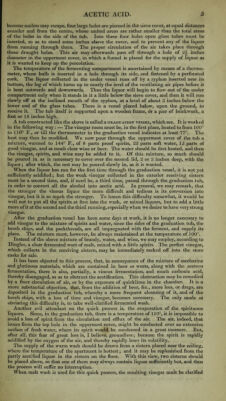
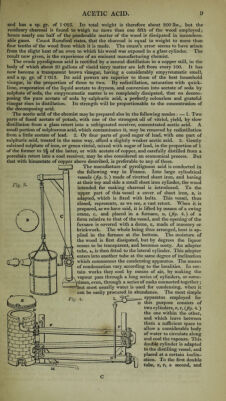
![sometimes a third, entirely similar, are connected, which, to save space, return upon them¬ selves in a zigzag fashion. The water is set in circulation by an ingenious means now adopted in many different manufactories. From the lower extremity, o, of the system of condensers, a perpendicular tube rises, whose length should be a little more than the most elevated point of the system. The water, furnished by a reservoir, l, enters by means of the perpendicular tube through the lower part of the system, and fills the whole space between the double cylinders. When the apparatus is in action, the vapours, as they condense, raise the temperature of the water, which, by the column in L G, is pressed to the upper part of the cylinders, and runs over by the spout k. To this point a very short tube is attached, which is bent towards the ground, and serves as an overflow. Tlie condensing apparatus is terminated by a conduit in bricks covered and sunk in the ground. At the extremity of this species of gutter is a bent tube, E, which discharges the liquid product into the first cistern. When it is full, it empties itself, by means of an overflow pipe, into a great reservoir; the tube which terminates the gutter plunges into the liquid, and thus intercepts communication with the inside of the appa¬ ratus. The disengaged gas is brought back by means of pipes M t, from one of the sides of the conduit to the under part of the ash pit of the furnace. These pipes are furnished with stopcocks M, at some distance in front of the furnacse, for the purpose of regulating the jet of the gas, and interrupting, at pleasure, communication with the inside of the apparatus. The part of the pipes which terminates in the furnace rises perpendicularly several inches above the ground, and is expanded like the rose of a watering can, n. The gas, by means of this disposition, can distribute itself uniformly under the vessel, without suflering the pipe which conducts it to be obstructed by the fuel or the ashes. The temperature necessary to effect the carbonisation is not considerable : however, at the last it is raised so high as to make the vessels red hot; and the duration of the process is necessarily proportional to the quantity of wood carbonised. For a vessel wliich shall contain about 5 meters cube (nearly 6 cubic yds.), 8 hours of fire is sufficient. It is known that the carbonisation is complete by the colour of the flame of the gas: it is first of a yellowish red ; it becomes afterwards blue, when more carbonic oxide than carbonic hydrogen is evolved ; and towards the end it becomes entirely white, — a circum¬ stance owing, probably, to the furnace being more heated at this period, and the combustion being more complete. There is still another means of knowing the state of the process, to which recourse is more frequently had ; that is the cooling of the first tubes, which are not surrounded with water : a few drops of this fluid are thrown upon their surface, and if they evaporate quietly, it is judged that the calcination is sufficient. The adopter tube is then unluted, and is slid into its junction pipe ; tlie orifices are immediately stopped with plates of iron and plaster loam. The brick cover, e, of the furnace is first removed by means of the swing crane, then the cylinder itself is lifted out and replaced immediately by another one previously charged. When the cylinder which has been taken out of the furnace is entirely cooled, its cover is removed, and the charcoal is em])tied. Five cubic meters of wood furnish about 7 chaldrons (voies) and a half of charcoal. (For modifications of the wood-vinegar apparatus, see Charcoal and Pyroi.ignous Acid.) Tlie different qualities oTwood employed in this operation give nearly similar products in reference to the acid ; but this is not the ease with the charcoal, for it is better the harder the wood; and it has been remarked, that wood long exposed to the air furnishes a charcoal of a worse quality than wood carbonised soon after it is cut. Having described the kind of apparatus employed to obtain pyrolignous acid, I shall now detail the best mode of purifying it. This acid has a reddish brown colour; it holds in solution a portion of empyreumatic oil and of the tar which were formed at the same time ; anotlier portion of these products is in the state of a simple mixture; the latter may be separated by repose alone. It is stated, above, that the distilling apparatus terminates in a subterranean reservoir, where the products of all the vessels are mixed. A common pump communicates with the reservoir, and sinks to its very bottom, in order that it may draw off only the stratum of tar, which, according to its greater density, occupies the lower part. From time to time the pump is worked to remove the tar as it is deposited. The reservoir has at its top an overflow pipe, which discharges tlie clearest acid into a cistern, from which it is taken by means of a second pump. The pyrolignous acid thus separated from the undissolved tar is transferred from this cistern into large sheet iron boilers, where its saturation is effected either by quicklime or by chalk ; the latter of which is preferable, as the lime is apt to take some of the tar into combination. The acid parts by saturation with a new portion of the tar, which is removed by skimmers. The neutral solution is then allowed to rest for a sufficient time to let its clear parts be drawn off by decantation. The acetate of lime thus obtained indicates by the hydrometer, before being mixed with the waters of edulooration, a degree corre.sponding to the acidimetric degree of the acid](https://iiif.wellcomecollection.org/image/b2930345x_0030.jp2/full/800%2C/0/default.jpg)
 No text description is available for this image
 No text description is available for this image
 No text description is available for this image