Volume 1
A history of the English poor law : in connection with the state of the country and the condition of the people / by Sir George Nicholls.
- George Nicholls
- Date:
- 1899
Licence: Public Domain Mark
Credit: A history of the English poor law : in connection with the state of the country and the condition of the people / by Sir George Nicholls. Source: Wellcome Collection.
Provider: This material has been provided by London School of Hygiene & Tropical Medicine Library & Archives Service. The original may be consulted at London School of Hygiene & Tropical Medicine Library & Archives Service.
78/484
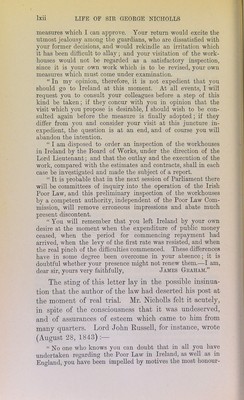
![measures which I can approve. Your return would excite the utmost jealousy among the guardians, who are dissatisfied with your former decisions, and would rekindle an irritation which it has been difficult to allay; and your visitation of the work- houses would not he regarded as a satisfactory inspection, since it is your own work which is to be revised, your own measures which must come under examination. “ In my opinion, therefore, it is not expedient that you should go to Ireland at this moment. At all events, I will request you to consult your colleagues before a step of this kind be taken; if they concur with you in opinion that the visit which you propose is desirable, I should wish to be con- sulted again before the measure is finally adopted ; if they differ from you and consider your visit at this juncture in- expedient, the question is at an end, and of course you will abandon the intention. “ I am disposed to order an inspection of the workhouses in Ireland by the Board of Works, under the direction of the Lord Lieutenant; and that the outlay and the execution of the work, compared with the estimates and contracts, shall in each case be investigated and made the subject of a report. “ It is probable that in the next session of Parliament there will be committees of inquiry into the operation of the Irish Poor Law, and this preliminary inspection of the workhouses by a competent authority, independent of the Poor Law Com- mission, will remove erroneous impressions and abate much present discontent. “ You will remember that you left Ireland by your own desire at the moment when the expenditure of public money ceased, when the period for commencing repayment had arrived, when the levy of the first rate was resisted, and when the real pinch of the difficulties commenced. These differences have in some degree been overcome in your absence; it is doubtful whether your presence might not renew them.—I am, dear sir, yours very faithfully, James Graham.” The sting of this letter lay in the possible insinua- tion that the author of the law had deserted his post at the moment of real trial. Mr. Nicholls felt it acutely, in spite of the consciousness that it was undeserved, and of assurances of esteem which came to him from many quarters. Lord John Russell, for instance, wrote (August 28, 1843):— “ ]STo one who knows you can doubt that in all you have undertaken regarding the Poor Law in Ireland, as well as in England, you have been impelled by motives the most honour-](https://iiif.wellcomecollection.org/image/b24764462_0001_0080.jp2/full/800%2C/0/default.jpg)