Licence: Public Domain Mark
Credit: Souvenir. Source: Wellcome Collection.
Provider: This material has been provided by the Augustus C. Long Health Sciences Library at Columbia University and Columbia University Libraries/Information Services, through the Medical Heritage Library. The original may be consulted at the the Augustus C. Long Health Sciences Library at Columbia University and Columbia University.
72/84 page 66
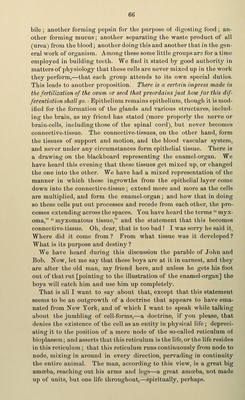
![bile ; another forming pepsin for the purpose of digesting food; an- other forming mucus; another separating the waste product of all (urea) from the blood; another doing this and another that in the gen- eral work of organism. Among these some little groups are for a time employed in building teeth. We find it stated by good authority in matters of physiology that these cells are never mixed up in the work they perform,—that each group attends to its own special duties. This leads to another proposition. There is a certain impress made in the fertilization of the ovum or seed that preordains just how far this dif- ferentiation shall go. Epithelium remains epithelium, though it is mod- ified for the formation of the glands and various structures, includ- ing the brain, as my friend has stated (more properly the nerve or brain-cells, including those of the spinal cord), but never becomes connective-tissue. The connective-tissues, on the other hand, form the tissues of support and motion, and the blood vascular system, and never under any circumstances form epithelial tissue. There is a drawing on the blackboard representing the enamel-organ. We have heard this evening that these tissues get mixed up, or changed the one into the other. We have had a mixed representation of the manner in which these ingrowths from the epithelial layer come down into the connective-tissue; extend more and more as the cells are multiplied, and form the enamel-organ ; and how that in doing so these cells put out processes and recede from each other, the pro- cesses extending across the spaces. You have heard the terms myx- oma, myxomatous tissue, and the statement that this becomes connective-tissue. Oh, dear, that is too bad ! I was sorry he said it. Where did it come from ? From what tissue was it developed ? What is its purpose and destiny ? We have heard during this discussion the parable of John and Bob. Now, let me say that these boys are at it in earnest, and they are after the old man, my friend here, and unless he gets his foot out of that rut [pointing to the illustration of the enamel-organ] the boys will catch him and use him up completely. That is all I want to say about that, except that this statement seems to be an outgrowth of a doctrine that appears to have ema- nated from New York, and of which I want to speak while talking about the jumbling of cell-forms,—a doctrine, if you please, that denies the existence of the cell as an entity in physical life; depreci- ating it to the position of a mere node of the so-called reticulum of bioplasson; and asserts that this reticulum is the life, or the life resides in this reticulum; that this reticulum runs continuously from node to node, mixing in around in every direction, pervading in continuity the entire animal. The man, according to this view, is a great big amoeba, reaching out his arms and legs—a great amoeba, not made up of units, but one life throughout,—spiritually, perhaps.](https://iiif.wellcomecollection.org/image/b21230237_0072.jp2/full/800%2C/0/default.jpg)