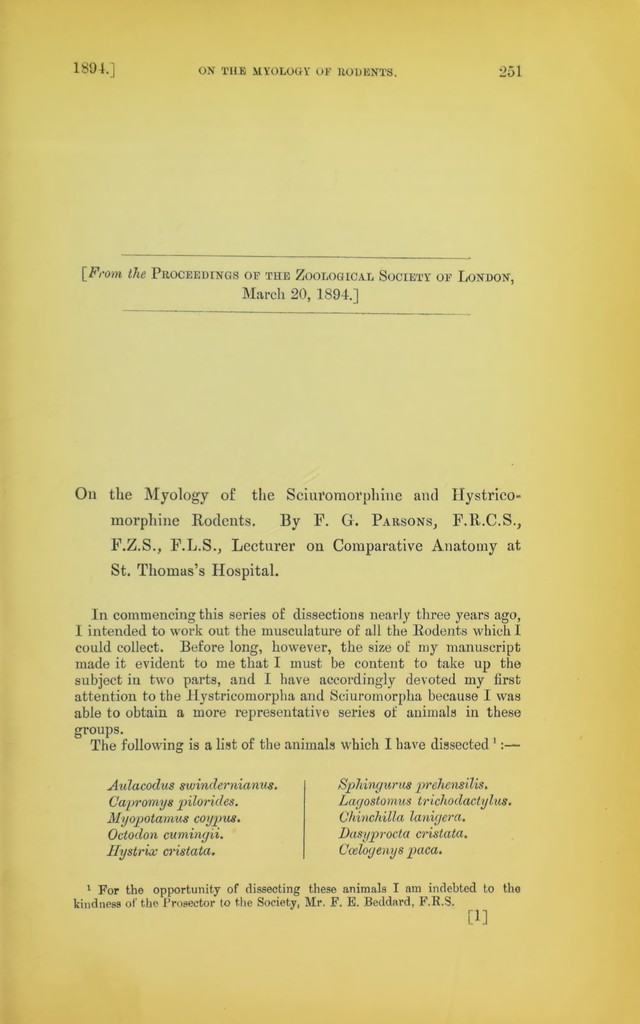
On the myology of the sciuromorphine and hystricomorphine rodents / by F.G. Parsons.
- Frederick Gymer Parsons
- Date:
- 1894
Licence: Public Domain Mark
Credit: On the myology of the sciuromorphine and hystricomorphine rodents / by F.G. Parsons. Source: Wellcome Collection.
Provider: This material has been provided by The Royal College of Surgeons of England. The original may be consulted at The Royal College of Surgeons of England.
16/48 page 264
![Wood 1 are well illustrated in the Rodents, though all three parts are seldom present together. They all rise from the tip of the coracoid process—the first part (rotator humeri) being inserted into the surgical neck of the humerus above the insertion of the latissimus dorsi tendon, the second part into the middle of the shaft of the humerus, while the third part runs down to the internal condyle. The musculo-cutaneous nerve always passes between the first and second parts when these are present. In the Dipodidte the first and third heads are present in D. cegyp- tins and D. hirtipes, but in Alectaga apparently the second only. In the Octodontidie only the second head is present (Aulacodus, Octodon, Capromys pilorides and melanurus2 3 4 5, Myopotamus). In the Hystricidse only the second part is present in Hystrix, while in Spliingurus, Erethizon dorsatus 3 and E. epixanthus4 the second and third heads are found. The third head in Spliingurus differed from the same part in the other animals I dissected in having the median nerve separating it from the rest of the muscle. In the Chiuchillidse only the second head is present in Chinchilla. In Lagostomus the muscle was entirely absent on both sides, but possibly this specimen was abnormal. In the Masvproctidae the first and second parts are present (Dasyprocta, Coelogenys). In the Caviidae only the second head is found (Cavia cobay a, Ccredon rupestris, DolichotisB). In the Sciuromorpha the rotator humeri is always present. In Sciurus, Pteromys, Xerus, and Spermophilus all three parts are found, but the second and third are blended. In Arctomys the first and second are present, while in Castor apparently the first and third are found. The lower part in this animal is inserted by a narrow tendon just above the inner condyle. Brachialis Anticus.—This muscle generally consists of an external and an internal part. The external rises from the back of the neck of the humerus and winds round to the front, lying just external to the pectoral ridge, which, when it is well marked as in Aidacodus, has a broad shallow groove for it to lie in. The internal head, when it is present, is much smaller and rises from the anterior border of the humerus below the pectoral ridge. The two parts are inserted into the ulna just below the lesser sigmoid cavity, a smaller slip being often sent to below and behind the tubercle of the radius. The muscle is supplied by the musculo-cutaneous and musculo-spiral nerves, but I was unable to satisfy myself that each head had a different nerve-supply. In the Octodontidie both heads are present. In the llystricidpe, Hystrix has both heads, while Spliingurus only has the external. 1 Journ. Anat. vol. i. p. 45. 2 Dobson, P. Z. S. 1884, p. 234. 3 Mivart, P. Z. S. 1882, p. 271. 4 Windle, Journ. Anat. vol. xxii. p. 126. 5 Beddard, P. Z. S. 1891, p. 236. [14]](https://iiif.wellcomecollection.org/image/b2238635x_0018.jp2/full/800%2C/0/default.jpg)