On the myology of the sciuromorphine and hystricomorphine rodents / by F.G. Parsons.
- Frederick Gymer Parsons
- Date:
- 1894
Licence: Public Domain Mark
Credit: On the myology of the sciuromorphine and hystricomorphine rodents / by F.G. Parsons. Source: Wellcome Collection.
Provider: This material has been provided by The Royal College of Surgeons of England. The original may be consulted at The Royal College of Surgeons of England.
22/48 page 270
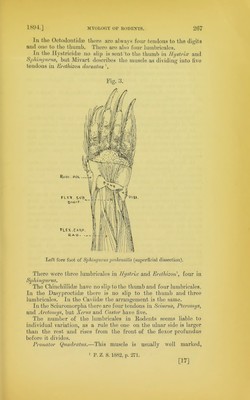
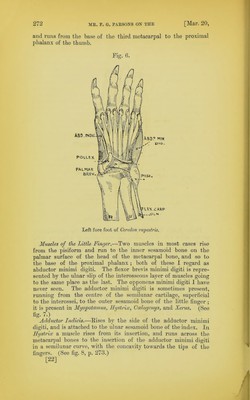
![Extensor Carpi Ulnaris.—This muscle possessed the same attachments as in Man with the exception of Sphingurus, in which the insertion had worked round to the palmar surface of the base of the fifth metacarpal bone. Supinator Brevis.—This muscle rises from the external condyle, and is inserted into the upper third of the extensor surface of the radius, wrapping round that bone very little. It only consists of one layer, which lies entirely superficial to the posterior inter- osseous nerve. Extensor Ossis Metacarpi Pollicis.—This muscle, which is generally well developed, rises from the extensor surfaces of the radius and ulna, or of the ulna alone, and from the interosseous membrane; its insertion is into the base of the first metacarpal bone and sometimes into the trapezium. In Hystrix the insertion is into the metacarpal bone and trapezium. In Cavia coibaya the insertion is into the trapezium, but in Mivart and Murie’s case it also sent a slip to the base of the second metacarpalIn the Sciuromorpha except Castor it rises from the ulna only. In Castor the muscle was double: the first part rose from the radius and was inserted into the first metacarpal, while the second rose from the radius and ulna and was inserted into the radial sesamoid bone of the palm. Extensor Primi Internoclii Pollicis.—This muscle was absent in all tbe animals examined. Meckel suggests that it may be incor- porated with the extensor ossis metacarpi. Extensor Secuncli Internoclii Pollicis.—This muscle was only found in Hystrix and Castor; in the former it arose from tbe ulna below the extensor ossis metacarpi, and was inserted by a thin tendon into the terminal phalanx of the first digit. In Castor it rises from the upper part of the dorsal surface of the ulna in common with the extensor indicis; it is inserted into the thumb as in Hystrix, but sends a slip to the common tendon on the dorsum of the index. Extensor Inclicis.-—-The extensor indicis rises from the dorsal surface of tbe ulna about its middle, and joins the tendon of the extensor communis digitorum on the dorsum of the index. In Hystrix a small slip was noticed, which ran down to lose itself on the dorsum of the fourth metacarpal bone. In Castor the muscle is blended with the extensor primi internodii as above stated. Palmaris Brevis.—This muscle is usually well marked and is attached to the pisiform bone and skin on the inner side of the palm ; from this it runs transversely across to the radial side, being interrupted by the palmar cartilage or cartilages to which it is attached. In the Dipodkhe, in which a transverse bar of bone runs across the palm, it is very slightly marked. In Capromys melanurus Dobson 2 describes it as sending a slip to act as the flexor perforates of the little finger ; this slip is what I describe, after Mivart and Murie, as flexor brevis manus. 1 P. Z. S. 1800, p. 383. 2 P. Z. S. 1884, p. 234. [20]](https://iiif.wellcomecollection.org/image/b2238635x_0024.jp2/full/800%2C/0/default.jpg)