On the myology of the sciuromorphine and hystricomorphine rodents / by F.G. Parsons.
- Frederick Gymer Parsons
- Date:
- 1894
Licence: Public Domain Mark
Credit: On the myology of the sciuromorphine and hystricomorphine rodents / by F.G. Parsons. Source: Wellcome Collection.
Provider: This material has been provided by The Royal College of Surgeons of England. The original may be consulted at The Royal College of Surgeons of England.
23/48 page 271
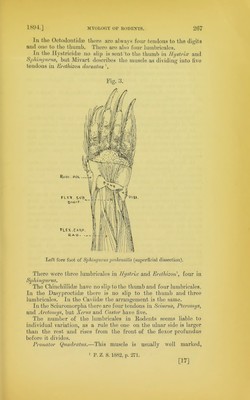
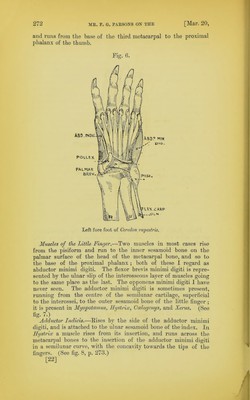
![In Coelogenys the muscle is interrupted by three palmar cartilages. Fig. 5. Flexor Brevis Manus.—This muscle rises from the palmar ossicle on the radial side of the palm, and runs obliquely across to form the flexor perforator for the fifth digit, usually joining the small flexor sublimis slip to that digit. It is supplied by the ulnar nerve. Muscles of the Thumb.—Owing to the slight development of the thumb these muscles are difficult to define accurately. The abductor pollicis is the most definite; it always rises from the radial part of the palmar cartilage, and is inserted into the base of the proximal phalanx of the thumb. In the Dipodidie and Caviidae this and the other thumb-muscles are practically absent. When the flexor brevis is present it rises either from the semi- lunar cartilage over the bases of the metacarpals (as in Coelogenys) or from the palmar cartilage (Capromys according to Dobson '). The oppoueus consists of a very few fibres ; it is found in most of the Sciuromorpha except Castor ; its attachments are from the above-mentioned semilunar cartilage to the metacarpal bone. The adductor is best marked in the Octodontidas (Octoclon, Myopotamus, and Capromys ‘) ; in Myopotamus it is quite distinct, 1 P. Z. S. 1884, p. 234. [21]](https://iiif.wellcomecollection.org/image/b2238635x_0025.jp2/full/800%2C/0/default.jpg)