The New Zealand War of 1863-64-65 : special report on wounds and injuries received in battle / by Inspector-General Mouat.
- Mouat, James, 1815-1899.
- Date:
- [between 1860 and 1869?]
Licence: Public Domain Mark
Credit: The New Zealand War of 1863-64-65 : special report on wounds and injuries received in battle / by Inspector-General Mouat. Source: Wellcome Collection.
Provider: This material has been provided by The Royal College of Surgeons of England. The original may be consulted at The Royal College of Surgeons of England.
3/56
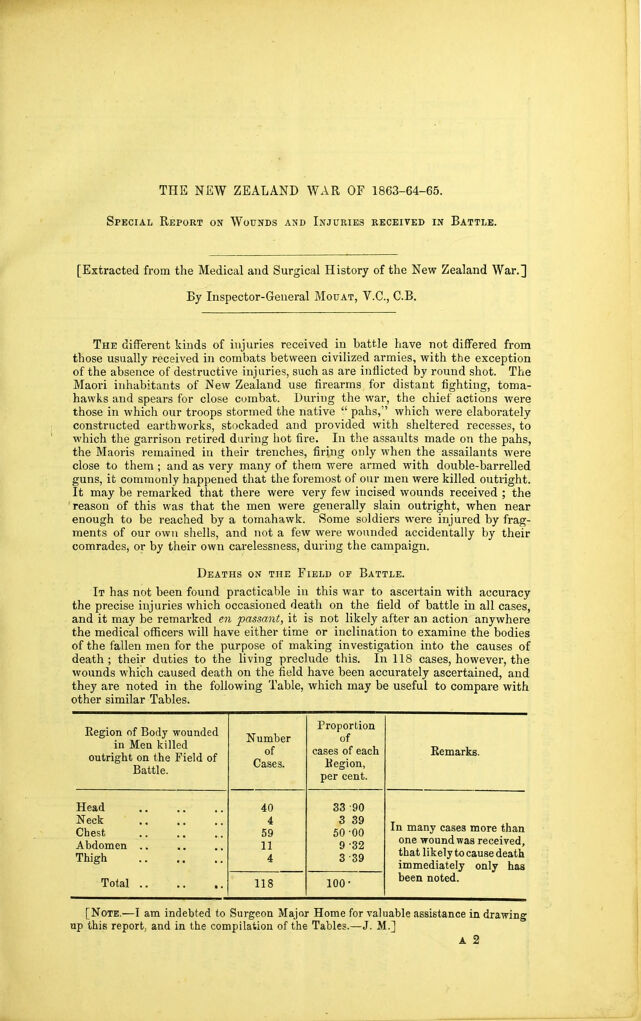
![THE NEW ZEALAND WAR OF 1863-64-65. Special Report on Wounds and Injuries received in Battle. [Extracted from the Medical and Surgical History of the New Zealand War.] By Inspector-General Mouat, V.G., C.B. The different kinds of injuries received in battle have not differed from those usually received in combats between civilized armies, with the exception of the absence of destructive injuries, such as are inflicted by round shot. The Maori inhabitants of New Zealand use firearms for distant fighting, toma- hawks and spears for close combat. During the war, the chief actions were those in which our troops stormed the native pahs, which were elaborately constructed earthworks, stockaded and provided with sheltered recesses, to which the garrison retired during hot fire. In the assaults made on the pahs, the Maoris remained in their trenches, firing only when the assailants were close to them ; and as very many of them were armed with double-barrelled guns, it commonly happened that the foremost of our men were killed outright. It may be remarked that there were very few incised wounds received ; the reason of this was that the men were generally slain outright, when near enough to be reached by a tomahawk. Some soldiers were injured by frag- ments of our own shells, and not a few were wounded accidentally by their comrades, or by their own carelessness, during the campaign. Deaths on the Field of Battle. It has not been found practicable in this war to ascertain with accuracy the precise injuries which occasioned death on the field of battle in all cases, and it may be remarked en passant, it is not likely after an action anywhere the medical officers will have either time or inclination to examine the bodies of the fallen men for the purpose of making investigation into the causes of death; their duties to the living preclude this. In 118 cases, however, the wounds which caused death on the field have been accurately ascertained, and they are noted in the following Table, which may be useful to compare with other similar Tables. Region of Body wounded in Men killed outright on the Field of Battle. Number of Cases. Proportion of cases of each Kegion, per cent. Remarks. Head Neck Chest Abdomen Thigh Total 40 4 59 11 4 S3 90 3 39 50 -00 9 32 3 39 In many cases more than one wound was received, that likely to cause death immediately only has been noted. 118 100- [Note.—I am indebted to Surgeon Major Home for valuable assistance in drawing up this report, and in the compilation of the Tables.—J. M.]](https://iiif.wellcomecollection.org/image/b22299622_0005.jp2/full/800%2C/0/default.jpg)