The New Zealand War of 1863-64-65 : special report on wounds and injuries received in battle / by Inspector-General Mouat.
- Mouat, James, 1815-1899.
- Date:
- [between 1860 and 1869?]
Licence: Public Domain Mark
Credit: The New Zealand War of 1863-64-65 : special report on wounds and injuries received in battle / by Inspector-General Mouat. Source: Wellcome Collection.
Provider: This material has been provided by The Royal College of Surgeons of England. The original may be consulted at The Royal College of Surgeons of England.
41/56 page 41
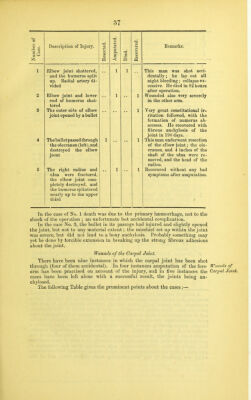
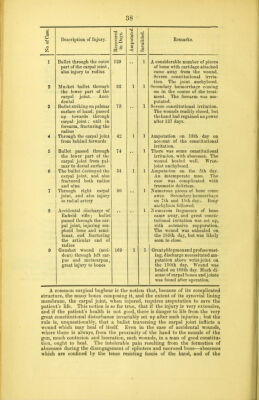
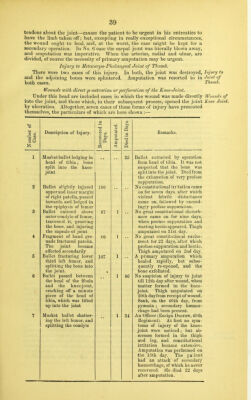
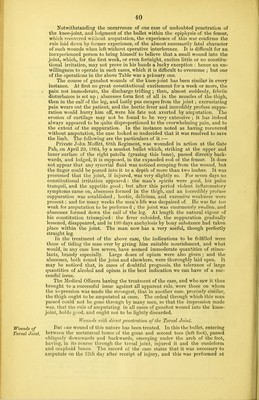
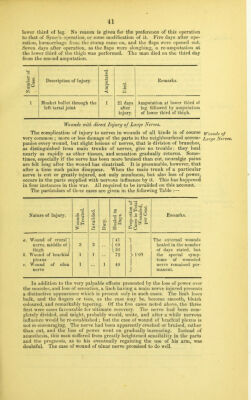
![lower third of leg. No reason is given for the preference of this operation to that of Syme's operation, or some modification of it. Five days after ope- ration, haemorrhage from the stump came on, and the flaps were opened out. Seven days after operation, as the flaps were sloughing, a re-amputation at the lower third of the thigh was performed. The man died on the third day from the second amputation. 4* o u •° % Description of Injury. 3 Remarks. gj a -6 is n 1 Musket bullet through the i 21 days Amputation at lower third of left tarsal joint after leg, followed by amputation injury. of lower third of thigh. Wounds with direct Injury of Large Nerves. The complication of injury to nerves in wounds of all kinds is of course jp-ounds of very common ; more or less damage of the parts in the neighbourhood accom- z,arge Nerves. panies every wound, but slight lesions of nerves, that is division of branches, as distinguished from main trunks of nerves, give no trouble : they heal nearly as rapidly as other tissues, and sensation gradually returns. Some- times, especially if the nerve has been more bruised than cut, neuralgic pains are felt long after the wound has cicatrized. It is presumable, however, that after a time such pains disappear. When the main trunk of a particular nerve is cut or greatly injured, not only numbness, but also loss of power, occurs in the parts supplied with nervous influence by it. This has happened in four instances in this war. All required to be invalided on this account. The particulars of these cases are given in the following Table :— Nature of Injury. Wounds Treated. Invalided. Duty. Healed in Days. Proportion of Cases to Total Wounded, per Cent. Eemarks. a. Wound of crural 1 [41 1 The external wounds nerve, middle of > 3 3 { 60 healed in the number thigh _ J [56 of days stated, hut h. Wound of brachial 1 1 72 > 1-03 the special symp- plexus toms of wounded c. Wound of ulna 1 ] 40 nerve remained per- nerve j manent. In addition to the very palpable effects presented by the loss of power over the muscles, and loss of sensation, a limb having a main nerve injured presents a distinctive appearance which is present only in such cases. The limb loses bulk, and the fingers or toes, as the case may be, become smooth, bluish coloured, and remarkably tapering. Of the five cases noted above, the three first were cases favourable for ultimate recovery. The nerve had been com- pletely divided, and might, probably would, unite, and alter a while nervous influence would be re-established ; but the case of wound of brachial plexus is not so encom-aging. The nerve had been apparently crushed or bruised, rather than cut, and the loss of power went on gradually increasing. Instead of anaesthesia, this man suffered from greatly heightened sensibility in the parts and the prognosis, as to his eventually regaining the use of his arm, was doubtful. The case of wound of ulnar nerve promised to do well.](https://iiif.wellcomecollection.org/image/b22299622_0043.jp2/full/800%2C/0/default.jpg)