Report of the trial of Prof. John W. Webster : indicted for the murder of Dr. George Parkman, before the Supreme judicial court of Massachusetts, holden at Boston, on Tuesday, March 19, 1850 / Phonographic report, by Dr. James W. Stone.
- Webster, John White, 1793-1850, defendant.
- Date:
- 1850
Licence: Public Domain Mark
Credit: Report of the trial of Prof. John W. Webster : indicted for the murder of Dr. George Parkman, before the Supreme judicial court of Massachusetts, holden at Boston, on Tuesday, March 19, 1850 / Phonographic report, by Dr. James W. Stone. Source: Wellcome Collection.
129/328 (page 121)
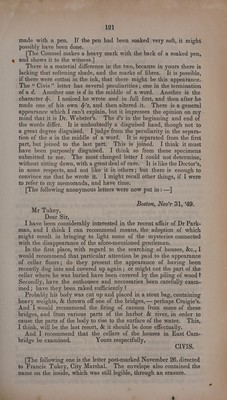
![made with a pen. If the pen had been soaked very soft, it might possibly have been done. [The Counsel makes a heavy mark with the back of a soaked pen, and shows it to the witness. | There is a material difference in the two, because in yours there is lacking that softening shade, and the marks of fibres. It is possible, if there were cotton in the ink, that there might be this appearance.. The “ Civis” letter has several peculiarities ; one in the termination of ad. Another one is d in the middle of a word. Another is the character g. I noticed he wrote and in full first, and then after he made one of his own &’s, and then altered it. ‘There is a general appearance which I can’t explain, but it impresses the opinion on my - mind that it is Dr. Webster’s. The d’s in the beginning and end of the words differ. It is undoubtedly a disguised hand, though not to a great degree disguised. I judge from the peculiarity in the separa- tion of the a in the middle of a word. It is separated from the first part, but joined to the last part. This is joined. I think it must have been purposely disguised. I think so from these specimens submitted to me. The most changed letter I could not determine, without sitting down, with a great deal of care. It is like the Doctor’s, in some respects, and not like it in others; but there is enough to convince me that he wrote it. I might recall other things, if I were to refer to my memoranda, and have time. [The following anonymous letters were now put in: —] Boston, Nov’r 31, 49. Mr Tukey, Dear Sir, I have been considerably interested in the recent affair of Dr Park- man, and I think I can recommend means, the adoption of which might result in bringing to light some of the mysteries connected with the disappearance of the afore-mentioned gentleman. In the first place, with regard to the searching of houses, &c., I would recommend that particular attention be paid to the appearance of cellar floors; do they present’ the appearance of having been recently dug into and covered up again; or might not the part of the cellar where he was buried have been covered by the piling of wood ? Secondly, have the outhouses and necessaries been carefully exam- ined; have they been raked sufficiently ? Probably his body was cut up and placed in a stout bag, containing heavy weights, & thrown off one of the bridges, — perhaps Craigie’s. And. I would recommend the firing of cannon from some of these bridges, and from various parts of the harbor & river, in order: to cause the parts of the body to rise to the surface of the water. This, I think, will be the last resort, & it should be done effectually. And I recommend that the cellars of the houses in East Cam- bridge be examined. Yours respectfully, CIVIS. [The following one is the letter post-marked November 26, directed to Francis Tukey, City Marshal. The envelope also contained the name on the inside, which was still legible, through an erasure.](https://iiif.wellcomecollection.org/image/b20443614_0129.jp2/full/800%2C/0/default.jpg)