Volume 1
The household physician : a family guide to the preservation of health and to the domestic treatment of ailments and disease, with chapters on food and drugs and first aid in accidents and injuries / by J. McGregor-Robertson ; with an introduction by John G. McKendrick.
- M'Gregor-Robertson, J. (Joseph), 1858-1925
- Date:
- 1899
Licence: Public Domain Mark
Credit: The household physician : a family guide to the preservation of health and to the domestic treatment of ailments and disease, with chapters on food and drugs and first aid in accidents and injuries / by J. McGregor-Robertson ; with an introduction by John G. McKendrick. Source: Wellcome Collection.
43/602 (page 9)
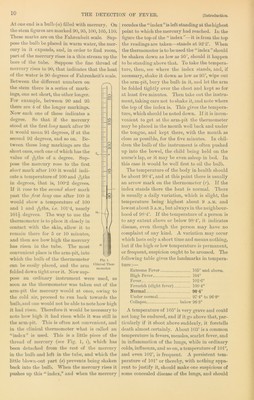
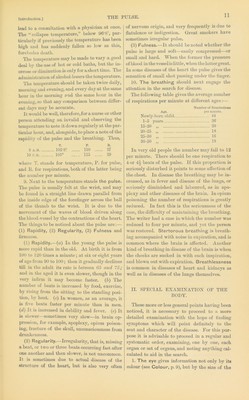
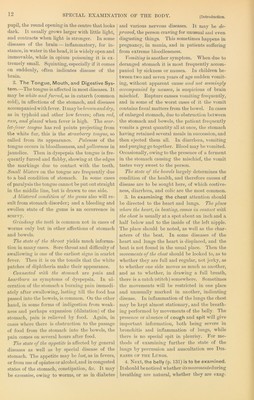
![Introduction.] nosis requires also a view of the person’s ante- cedents (his family history), of his social rela- tionships, and of similar circumstances already referred to in discussing causes of disease. We shall briefly glance at some of the leading thino-s that should be noticed in the endeavour o to form such a diagnosis, I. GENERAL EXAMINATION OF THE BODY. 1. Form.—Look at the outline of the body to detect anything unusual in shape of bones or joints, and compare the two sides of the body. A displacement or break of a bone will be readily seen by the difference between the two sides; swellings, &c., will also in this way be more evident. Note also “ pitting” of small-pox, scars of old wounds or abscesses, especially if over glands, in which case they may suggest a scrofulous taint. 2. Weight.—In most diseases weight is af- fected; and if the person can have a note of several weighings, at regular intervals, it will easily be seen whether weight is increasing-—• generally favourable—or diminishing—gene- rally serious. The following table gives the proportion of weight to height:— A man of 4 ft. 6 in. to 5 ft. 0 in. ought to weigh about 92 lbs. M 0 ir 5 11 1 M M M 115 M M 2 If 5 m3 M M M 127 M t. 4 It 5 11 5 M M M 139 M II 6 ir 5 M 7 M M M 144 M II 8 tt 5 11 9 ir M M 157 M II10 11 5 Mil M M M 170 M nil M 0 M 0 M M M 177 M II 0 If M M 218 M These weights do not include clothing. There ought always to be increase in weight up to 45 years of age. 3. Proportion of Parts. — Note whether bones, muscles, and fat seem to have their due proportion. Some people “ seem all bones: ” two men of the same apparent bulk may be very different, the one showing firm, hard muscles, the other being soft and flabby, and evidently more fatty than musculai’. These two will stand, obviously, in a very different position as regards disease; the one likely to resist it with vigour and success, the other to be speedily over- come by it. 4. Colour.—The skin may be 'pale from de- ficient quantity of blood or inferior quality, which may arise from improper nourishment (bad feed- ing, dyspepsia), from loss of blood, or from some disease interfering with the blood (disease of kidney, &c.). Full-blooded persons with a ten- dency to apoplexy will be florid; redness of skin also occurs in fevered states. Yellowness is as- sociated with liver disease, and is soonest seen in the white of the eyes. Blueness (cyanosis) may indicate disease of the lungs, or may be due to disease of the heart preventing the proper aeration of the blood (p. 258), and is soonest seen on the lips. Bronzing occurs in a peculiar afl’ection called Addison’s disease. 5. Dropsical Swellings. — These most fre- quently occur soonest at feet and ankles, and can be shown by pressing firmly on the skin with the finger for a short time. On removing the finger, a “pit” remains which slowly fills up. Such a swelling beginning in the face, at lower eyelid, is oftenest due to kidney disease. A prominent appearance of the belly is often due to dropsy. 6. Expression of Face.—The face affords most valuable evidence of disease. As regards its colour, see Paragraph 4, Colour. In low fevers it may be dull and expressionless, in high fevers flushed and excited. One side may pre- sent a smooth appearance without wrinkle, the other may be more than usually torinlded and drawn, indicating paralysis. Squint may in- dicate brain disease; prominent eyeballs, goitre. 7. Attitude.—The mode of standing, sitting, or disposing of limbs is often suggestive. For example, a patient suffering from acute inflam- mation of the belly lies in bed with the knees drawn up towards the head, and resists any attempt to stretch them down; a child with spinal disease high up in the neck will keep head, neck, and shoulders stiff and immovable to prevent pain. 8. A point of the utmost importance in detec- tion of disease is the accurate determination of the amount of heat of the blood, as indicat- ing the approach or actual presence of fever. This is done very roughly by feeling with the hands the heat of the skin, but this method is never accurate. Often a person will com})lain of great heat, and seem fevered, when actually the temperature is of the usual amount; while, on the other hand, as in the fii'st sta^e of inter- mittent fevers, the person may be shivering and complain of cold, and the skin have all the appearance of cold, when the temperature is actually above what is usual. The only satis- factory way of judging the amount of heat, the degree of temperature, is by means of a ther- mometer. The best kind of thermometer is one made for the purpose,called a clinical thermometer (Fig. 1), that is, one for use at the bedside. The figure shows one just about the usual size. It consists of a tube with very thick walls and a very fine bore.](https://iiif.wellcomecollection.org/image/b28124674_0001_0043.jp2/full/800%2C/0/default.jpg)