Volume 1
The household physician : a family guide to the preservation of health and to the domestic treatment of ailments and disease, with chapters on food and drugs and first aid in accidents and injuries / by J. McGregor-Robertson ; with an introduction by John G. McKendrick.
- M'Gregor-Robertson, J. (Joseph), 1858-1925
- Date:
- 1899
Licence: Public Domain Mark
Credit: The household physician : a family guide to the preservation of health and to the domestic treatment of ailments and disease, with chapters on food and drugs and first aid in accidents and injuries / by J. McGregor-Robertson ; with an introduction by John G. McKendrick. Source: Wellcome Collection.
539/602 (page 467)
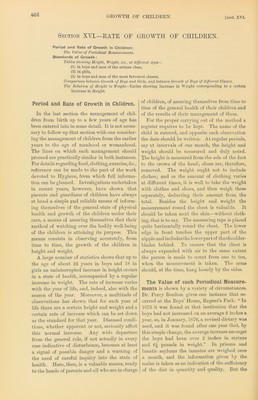
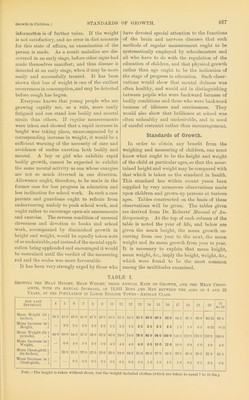
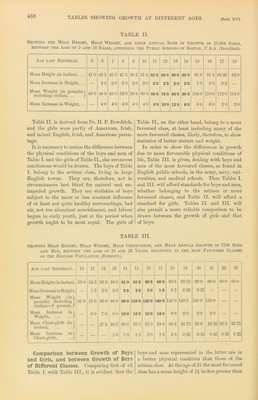
![informatimi is of furt'her value. If the weight is not satisfactory, and no error in diet accounts for this state of affairs, an examination of the person is made. As a result maladies are dis- covered in an early stage, before other signs had made themselves manifest; and thus disease is detected at an early stage, when it may be more easily and successfully treated. It has been shown that loss of weight is one of the earliest occurrences in consumption,and may be detected before cough has begun. Everyone knows that young people who are growing rapidly are, as a rule, more easily fatigued and can stand less bodily and mental strain than others. If regular measurements were taken and showed that a rapid increase in height was taking place, unaccompanied by a corresponding increase in weight, it would be a sufficient warning of the necessity of care and avoidance of undue exertion both bodily and mental. A boy or girl who exhibits rapid bodily growth, cannot be expected to exhibit the same mental activity as one whose energies are not so much diverted in one direction. Allowance ought, therefore, to be made in the former case for less pi'ogress in education and less inclination for school work. In such a case parents and guardians ought to refrain from endeavouring unduly to push school work, and ought rather to encourage open-air amusements and exercise. The reverse condition of unusual cleverness and devotion to books and school work, accompanied by diminished growth in height and weight, would be equally taken note of as undesirable,and instead of the mental appli- cation being applauded and encouraged it would be restrained until the verdict of the measurin£r rod and the scales was more favourable. It has been very strongly urged by those who have devoted special attention to the functions of the brain and nervous diseases that such methods of regular measurement ought to be systematically employed by schoolmasters and all who have to do with the regulation of the education of children, and that physical growth rather than age ought to be the indication of the stage of progress in education. Such obser- vations would show that mental dulness was often healthy, and would aitl in distinguishing between pupils who were backward because of bodily conditions and those who were backward because of idleness and carelessness. They would also show that brilliance at school was often unhealthy and undesirable, and in need of careful restraint rather than encouragement. Standards of Growth. In order to obtain any benefit from the weighing and measuring of children, one must know what ought to be the height and weight of the child at particular ages, so that the ascer- tained height and weight may be compared with that which is taken as the standard in health. This standard has within recent years been supplied by veiy numerous observations made upon children and grown-up persons at various ages. Tables constructed on the basis of these observations will be given. The tables given are derived from Dr. Roberts’ Manual of An- thropometry. At the to]) of each column of the table is noted the year of life, and below are given the mean height, the mean growth oc- curring from one year to the next, the mean weight and its mean growth from year to year. It is necessary to explain that mean height, mean weight, &c., imply the height, weight, &c., which were found to be the most common among the multitudes examined. TABLE I. Showing the Mean Height, Mean Weight, their Annual Rate of Growth, and the I^Iean Chest- girth, WITH ITS Annual Increase, op 13,931 Boys and IMen between the ages of 4 and 22 Vears, of the Population in Large English Towns—Artisan Class. Age last Birthday. 4 5 6 7 8 9 10 11 12 13 14 15 16 17 18 19 20 21 to 22 Afean Height (in ( inches), .. ) 3S-5 41-0 43-0 45 0 47 0 49 0 505 51-5 63 0 55 5 580 60 5 63 0 64-5 65 5 00-0 66-25 66 5 Mean Increase in)^ Height, — 2 0 2 5 2 0 2 0 2 0 1-5 10 1'5 2 5 2 5 2 5 2 5 1-5 10 0-5 0-25 0-25 Alean Weight (in | pounds), .. ) 44 0 50 0 .54 0 57 0 59 0 62 0 60 0 70-0 74 0 78 0 84 0 94 0 106 0 116 0 122-0 128 0 132-0 136-0 Mean Increase in t Weight, .. j — 6 0 4 0 3 0 2 0 3-0 4 0 4 0 4 0 4 0 60 10 0 12 0 10 0 60 6 0 4-0 4 0 Alean Chest-girth \ (in inches), .. ) — 21-0 21-5 22 0 22-5 23-0 23-5 24 0 24-5 25 0 26 0 27-0 28-5 29-5 30 0 30 5 31 0 31-5 Alean Increase in | Chest-girth, .. f — — 0 5 0 5 0’5 0-5 0*5 0*5 0-5 0-5 10 10 1-5 10 0-5 0-5 0-5 0-5 j\ ote. The height is taken without shoes, but the weight included clothes (which are taken to equal 7 to 10 lbs.).](https://iiif.wellcomecollection.org/image/b28124674_0001_0539.jp2/full/800%2C/0/default.jpg)