Volume 1
The household physician : a family guide to the preservation of health and to the domestic treatment of ailments and disease, with chapters on food and drugs and first aid in accidents and injuries / by J. McGregor-Robertson ; with an introduction by John G. McKendrick.
- M'Gregor-Robertson, J. (Joseph), 1858-1925
- Date:
- 1899
Licence: Public Domain Mark
Credit: The household physician : a family guide to the preservation of health and to the domestic treatment of ailments and disease, with chapters on food and drugs and first aid in accidents and injuries / by J. McGregor-Robertson ; with an introduction by John G. McKendrick. Source: Wellcome Collection.
542/602 (page 470)
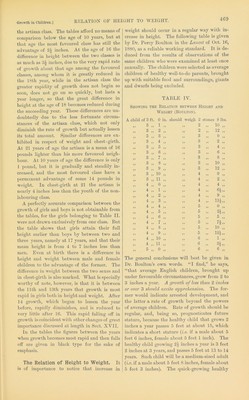
![HOW TO USE THE TABLES OF GROWTH. [Sect. XVI. child that accomplishes 3 inches a year passes 5 feet at 10 or 11, and eventually makes a tall adult {i.e. if a male about 5 feet 10 inches, female about 5 feet 5 inches). ... Of course one meets with many variations, but these vari- ations are, I believe, always abnormal. Some children seem to do their growing by fits and starts, the common diseases of children arrest- ing, for the time, their progress, which is made up for afterwards by a supreme effort. Such growth is unnatural and often very detrimental. 1 believe, then, that every healthy child has its own regular rate of growth of 2, 2j, or 3 inches a year, from which it has no right to vary more than I inch a year.” “Next as to weight for height, whether a child grows 2, 24, or 3 inches a year, weight for height should be, in each case, identically the same; and all children should grow broad in proportion to their height. Between 3 and 4 feet the increase in weight shoidd, 1 find, he 2 pounds per inch, and between 4 and 5 feet 2^ pounds per inchP . . . “ Some children exceed these weights (those given in Table IV.) that are by no means giants, and really healthy, well-nourished children of healthy parents and favourable surroundings generally attain these averages. But what of children that fall below the standai'dl I find that there is a 7-pound margin of safety, and that children falling more than 7 pounds below this standard are devoid of reserve capital on which to draw, and, consequently, they succumb quickly to many constitutional diseases. This, therefore, may be called the preventive-medicine margin, beyond which lies the dangerous land of cachexia” (a depraved condition of body). “Arrest of growth or lo.ss of weight precedes so many di.seases that it may be looked upon as a danger signal; and, if the caution is noticed before the disease point is reached, catastrophe may frequently be prevented.” These tables are given as standards for refer- ence, and brief suggestions will be given in closing this section as to their method of use. Each child should be weighed and its height taken once a month, or at least once a quarter. Reference should then be made to Table I. or III. in the case of boys, according to the class to which the child belongs, the labouring or more favoured class, or to Table II. in the case of girls. It will thus be seen whether the child reaches the standard for its age. The column of the table is taken headed with the age of the child at its last birthday; and in that column will be found the height, weight, and chest-girth to which it should reach. The results of eacb weighing and measuring should be noted in a book kept for the pui’])ose, the date being accurately entered. The increase that has taken place since the last trial should be noted and compared with the standard in the tables. Lastly, the height of the child should be referred to Table IV., and it should be noticed whether the weight reaches to that mentioned in the table as jjroper to the particular height. Of course there will be variations. Any con- siderable variation, howevei’, and specially any sudden variation, should lead to careful con- sideration of all the child’s circumstances, its food, the fresh air and exercise obtainable by it, the amount of school and other work, &c. Some change in these may at once be suggested. If no such circumstance seems to account for the departure from the rule, medical advice should be sought. Especially between the ages of 11 and 17 should the results of the weighing - chair and measuring-rod be carefully watched. They will throw light on the qiiestion of over-pressure at school, and, if their warning is accepted, will do much to prevent it. Every school ought to have a room set a]iart and equipped for the weighing and measuring of the pupils. The standai’ds of weight and height should be jDaiuted on the walls, and each pupil’s height, weight, and chest-girth shouhl be registered at regular ])eriods. Educa- tion w'ould then have a better chance of being conducted on ])hysiological principles, and with some regard to the jdiysical development of the pu))ils.](https://iiif.wellcomecollection.org/image/b28124674_0001_0542.jp2/full/800%2C/0/default.jpg)