Volume 1
The household physician : a family guide to the preservation of health and to the domestic treatment of ailments and disease, with chapters on food and drugs and first aid in accidents and injuries / by J. McGregor-Robertson ; with an introduction by John G. McKendrick.
- M'Gregor-Robertson, J. (Joseph), 1858-1925
- Date:
- 1899
Licence: Public Domain Mark
Credit: The household physician : a family guide to the preservation of health and to the domestic treatment of ailments and disease, with chapters on food and drugs and first aid in accidents and injuries / by J. McGregor-Robertson ; with an introduction by John G. McKendrick. Source: Wellcome Collection.
546/602 (page 474)
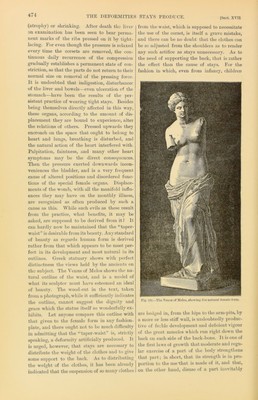
![THE DEFORMITIES STAYS PRODUCE. [Sect. XVII (atrophy) or shrinking. After death the liver on examination has been seen to bear perma- nent marks of the ribs pressed on it by tight- lacing. For even though the pressure is relaxed every time the corsets are removed, the con- tinuous daily recurrence of the compression gradually establishes a permanent state of con- striction, so that the pai’ts do not return to their normal size on removal of the pressing force. It is undoubted that indigestion, disturbances of the liver and bowels—even ulceration of the stomach—have been the results of the per- sistent practice of wearing tight stays. Besides being themselves directly affected in this way, these organs, according to the amount of dis- placement they are bound to experience, alter the relations of others. Pressed upwards they encroach on the space that ought to belong to heart and lungs, breathing is disturbed, and the natural action of the heart interfered with. Palpitation, faintness, and many other heart symptoms may be the direct consequences. Then the pressure exerted downwards incon- veniences the bladder, and is a very frequent cause of altered positions and disordered func- tions of the special female organs. Displace- ments of the womb, with all the manifold influ- ences they may have on the monthly illness, are recognized as often ju'oduced by such a cause as this. While such evils as these result from the practice, what benefits, it may be asked, are supposed to be derived from it? It can hardly now be maintained that the “taper- waist” is desirable from its beauty. Any standard of beauty as regards human form is derived rather from that which appears to be most per- fect in its development and most natural in its outlines. Greek statuary shows with ])erfect distinctness the views held by the ancients on the subject. The Venus of Melos shows the na- tural outline of the waist, and is a model of what its sculptor must have esteemed an ideal of beauty. The wood-cut in the text, taken from a ])hotograph, while it sufficiently indicates the outline, cannot suggest the dignity and grace which the statue itself so wonderfully ex- hibits. Let anyone compare this outline with that given to the female form in any fashion- plate, and there ought not to be much difficulty in admitting that the “taper-waist” is, .strictly speaking, a deformity artificially produced. It is urged, however, that stays are necessary to distribute the weight of the clothes and to give some support to the back. As to distributing the weight of the clothes, it has been ali’eady indicated that the suspension of so many clothes from the waist, which is supposed to nece.ssitate the use of the corset, is itself a grave mistake, and there can be no doubt that the clothes can be so adjusted from the shoulders as to render any such artifice as stays unnecessary. As to the need of supportiiig the back, that is i-ather the effect than the cause of stays. For the fashion in which, even from infanc}', children Fig. 182.—The Venus of Melos, showing the natural female form. are hedgeil in, from the hips to the arm-jnts, by a more or less stiff wall, is undoubtedly produc- tive of feeble development and deficient vigour of the great muscles which run right down the back on each side of the back-bone. It is one of the first laws of growth that moderate and regu- lar exercise of a part of the body strengthens that part; in short, that its strength is in ]>ro- portion to the use'that is made of it, and that, on the other liand, disuse of a jiart inevitably](https://iiif.wellcomecollection.org/image/b28124674_0001_0546.jp2/full/800%2C/0/default.jpg)