Volume 1
The household physician : a family guide to the preservation of health and to the domestic treatment of ailments and disease, with chapters on food and drugs and first aid in accidents and injuries / by J. McGregor-Robertson ; with an introduction by John G. McKendrick.
- M'Gregor-Robertson, J. (Joseph), 1858-1925
- Date:
- 1899
Licence: Public Domain Mark
Credit: The household physician : a family guide to the preservation of health and to the domestic treatment of ailments and disease, with chapters on food and drugs and first aid in accidents and injuries / by J. McGregor-Robertson ; with an introduction by John G. McKendrick. Source: Wellcome Collection.
547/602 (page 475)
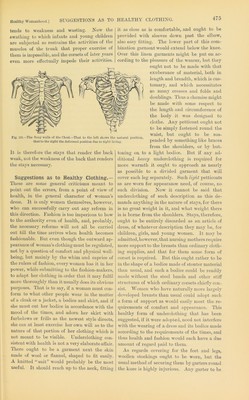
![SUGGESTIONS AS TO HEALTHY CLOTHING. tends to \veaknes.s and wasting. Now the swathing to which infants and young children are subjected so resti'ains the activities of the muscles of the trunk that proper exercise of them is impossible, and the coi’sets of later years even more effectually impede their activities. It i.s therefore the stays that render the back weak, not the weakness of the back that renders the stays necessary. Siig-g-estions as to Healthy Clothing.— These are some general criticisms meant to point out the errors, from a point of view of health, in the general character of woman’s dress. It is only women themselv^es, however, who can successfully carry out any reform in this direction. Fashion is too imperious to bow^ to the authority even of health, and, probably, the necessary reforms will not all be carried out till the time arrives when health becomes fashionable. But ev’en though the outward ap- pearance of woman’s clothing must be regulated, not by a question of comfort and physical well- being, but mainly by the whim and caprice of the rulers of fashion, eveiy woman has it in her power, while submitting to the fashion-makers, to adapt her clothing in order that it may fulfil more thoroughly than it usually does its obvious purposes. That is to say, if a w'oman must con- form to what other peo]jle wear in the matter of a cloak or a jacket, a bodice and skirt, and if she must cut her bodice in accordance with the mood of the times, and adorn hei’ skirt with furbelows or frills as the newest style directs, she can at least exercise her owii will as to the nature of that portion of her clothing which is not meant to be visible. Underclothing con- sistent with health is not a very elaborate affair. There ought to be a garment next the skin made of wool or flannel, shaped to fit easily. A knitted “suit” would probably be the most useful. It should reach u]i to the neck, fitting it as close as is comfortable, and ought to be provided with sleeves down past the elbow, also easy fitting. The lower part of this com- bination garment would extend below the knee. Over this linen garments might be put on ac- cording to the pleasure of the wearer, but they ought not to be made with that exuberance of material, both in length and breadth, which is cus- tomary, and which necessitates so many creases and folds and doublings. Thus a chemise might be made with some respect to the length and circumference of the body it was designed to clothe. Any petticoat ought not to be sim])ly fastened round the waist, but ought to be sus- pended by something like braces from the shoulders, or by but- toning on to a light bodice. But if any ad- ditional heavy underclothing is required for more warmth it ought to approach as nearly as possible to a divided garment that will cover each leg separately. Such light petticoats as are worn for appearance need, of course, no such division. Now it cannot be said that underclothing of such description as this de- mands anything in the nature of stays, for there is no great weight in it, and what weight there is is borne from the shoulders. Stays, therefore, ought to be entirel}’^ discarded as an article of dress, of whatever description they may be, for children, girls, and young women. It may be admitted, howev^er, that nursing mothers require more support to the breasts than ordinaiy cloth- ing su])plies, and that for them some form of corset is required. But this ought rather to be in the shape of a bodice made of stouter material than usual, and such a bodice could be readily made without the steel bands and other stiffs structures of which ordinary corsets chiefly con- sist. Women who have naturally more largely developed breasts than usual could adopt such a form of support as would easily meet the re- quirements of comfort and apjiearance. This healthy form of underclothing that has been suggested, if it were ado])led, need not interfere with the wearing of a dress and its bodice made according to the requirements of the times, and thus health and fa.shion would each have a due amount of regard ]>aid to them. As regards covering for the feet and legs, woollen stockings ought to be worn, but the usual method of securing them by garters round the knee is highly injurious. Any garter to be Fig. 183.—The Bony walls of the Chest.—That to the left shows the natural position, that to the right the deformed position due to tight lacing.](https://iiif.wellcomecollection.org/image/b28124674_0001_0547.jp2/full/800%2C/0/default.jpg)