Volume 1
The household physician : a family guide to the preservation of health and to the domestic treatment of ailments and disease, with chapters on food and drugs and first aid in accidents and injuries / by J. McGregor-Robertson ; with an introduction by John G. McKendrick.
- M'Gregor-Robertson, J. (Joseph), 1858-1925
- Date:
- 1899
Licence: Public Domain Mark
Credit: The household physician : a family guide to the preservation of health and to the domestic treatment of ailments and disease, with chapters on food and drugs and first aid in accidents and injuries / by J. McGregor-Robertson ; with an introduction by John G. McKendrick. Source: Wellcome Collection.
550/602 (page 478)
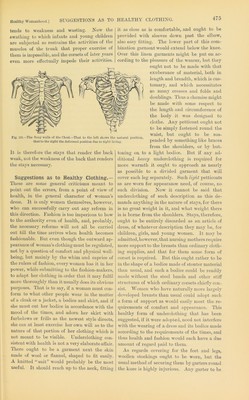
![COLLEGES FOR WOMEN. [Sect. XVII. for iutermittent work by the one se.x. It be- comes, therefore, the duty of every honest phy- sician to make no secret of the mischief which must inevitably accrue, not only to many of our young women, but to our whole population, if the distinction of sex be disregarded.” If, however, we carefully consider the bur- den of the objections raised to the full education of girls, and the recent developments of female education in England and America, some way out of the maze created by these differences of authority seems possible. We have to consider that many women find the necessity of earning their livelihood in occupations requiring careful education and a large amount of mental toil, and we find a large and daily increasing num- ber of women who value the highest education, not for what it will bring, but for its own sake. The claims of neitlier of these can be disre- garded. Up to the age of twelve years there is no reason why girls should not receive an educa- tion equal to, if not identical with, that given to boys. It is after that age that difhculties arise due to the special circumstances of sex. It is about that age that special developments take place in the training of boys dependent upon their intended course through life. If they mean to go in for commercial pursuits, the edu- cation is moulded in accordance with that in- tention, if for professional life, they go on to training preliminaiy to the universities. If they are boys who, by reason of their position, can afford to pursue an education whose immediate object is culture, and whose ulterior object may be determined at a much later period, accord- ing merely to fancy or inclination, the higher education of the secondary school and the uni- versity is proceeded with. Tliis age is also the time when, in the case of girls, the special cir- cumstances dependent on her sex require to be taken into consideration. The Americans seem to find that if, after that age, whatever may have been the system adopted before it, the education of girls is directed with special re- gard to her physiological necessities, that is with regard to the monthly changes which periodically occur, all danger may be averted. This almost implies that girls be taught, after that age, in secondary schools set apart for them- selves, where they do not enter into competition with boys, and where, on that account, a perio- dical relaxation of studies may be permitted to occur without throwing one set of pupils out of line with another in rate of study. Still further to diminish all tendency to overstraining, the best American opinion seems to indicate the advisability of abolishing competitive work and examination among girls, and it is found that the love of work itself supplies sufficient stimu- lus to requisite exertion, that, even where com- petition is not engaged in, the eager desire for learning requires careful watching to hold it sufficiently in check. Similarly colleges for women only, where like care and supervision are exercised, seem preferable to mixed colleges where an unhealthy straining to excel is almost certain to exist. Such a regulation of study, in accordance with girls’ physiological require- ments, is only possible in an institution exclu- sively devoted to girls. Overpressure in education has.as pernicious an effect on boys as it has on girls. That evil is got rid of by proper regulation of study, and, along with care in diet, &c., by means of a due amount of exercise and recreation. This general rule is applicable to girls as well as to boys. The special objection in the case of girls is that the continu- mental application is not consistent with the special demands made upon a girl’s energies at regularly returning periods connected with her peculiar functions. That objection, we believe, is met by such provisions as have been already indicated, which, however, as we have already said, can only be properly made in secondary schools and in colleges devoted exclusively to the female sex, and regulated with due regard to these functional peculiarities. In short, the objections that have been urged against the according of the highest education to girls do not strictly lie against the education itself, but against the system on which it has been con- ducted. The arguments are not logically against giving the same education to girls as to boys, but against giving that education in the same xoaij. We believe the difference in the testi- mony that came from America at an early period in the movement for higher education, which was not in its favour, and the later testimony, when better methods had been devised, and which was in its favour, is simply due to that fact that the necessity for periodical relaxation had not been recognized at the early period, and was fully realized at the later. Thus one teacher in giving evidence before the State Board of Massachusetts, in 1874, said: “ At cer- tain periods I think that study with girls should Avholly cease for some days. I refer to girls from twelve to twenty years of age. Anyone who has taught boys and girls—in separate schools, I mean—must have noticed tlie greater pro])ortionate irregularity of attendance of the latter, and as a parent he would know the reason](https://iiif.wellcomecollection.org/image/b28124674_0001_0550.jp2/full/800%2C/0/default.jpg)