Volume 1
The household physician : a family guide to the preservation of health and to the domestic treatment of ailments and disease, with chapters on food and drugs and first aid in accidents and injuries / by J. McGregor-Robertson ; with an introduction by John G. McKendrick.
- M'Gregor-Robertson, J. (Joseph), 1858-1925
- Date:
- 1899
Licence: Public Domain Mark
Credit: The household physician : a family guide to the preservation of health and to the domestic treatment of ailments and disease, with chapters on food and drugs and first aid in accidents and injuries / by J. McGregor-Robertson ; with an introduction by John G. McKendrick. Source: Wellcome Collection.
551/602 (page 479)
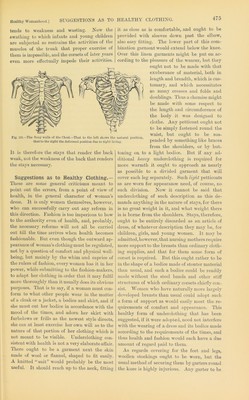
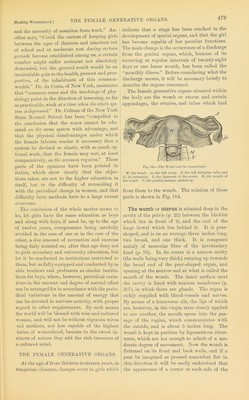
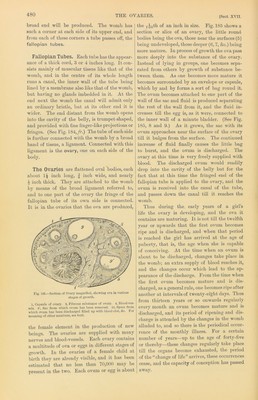
![THE FEMALE GENERATIVE ORGANS. ami the necessity of cessation from work.” An- other says, “Could the custom of keejung girls between the ages of thirteen and nineteen out of school and at moderate rest during certciin periods become established among us, a certain number might sutler restraint not absolutel} demanded, but the general result would be an incalculable gain to the health, present and [>ros- pective, of the inhabitants of this common- wealth.” Dr. da Costa, of New York, maintains that “common sense and the teachings of phy- siology ])oint in the direction of lessening, as far as practicable, work at a time when the whole sys- tem is depressed^ Dr. Cob ran of the New \ork State Normal School has been “compelled to the conelusiou that the sexes cannot be edu- cated on the same system with advantage, and that the physical disadvantages under which the female labours render it necessary that a system be devised so elastic, with so much op- tional work, that the female may rest, at least comparatively, as the occasion requires.” Those parts of the opinions have been printed in italics, which show clearly that the objec- tions taken are not to the higher education in itself, but to the difficulty of reconciling it with the periodical change in women, and that difficulty later methods have to a large extent overcome. The conclusion of the whole matter seems to be, let girls have the same education as boys and along with boys, if need be, up to the age of twelve years, overpressure being carefully avoided in the case of one as in the case of the other, a due amount of recreation and exercise being daily insisted on; after that age deny not to girls secondary and university education, but let it be conducted in institutions restricted to them, but as fully equipped and conducted by as able teachers and pi'ofessors as similar institu- tions for boys, where, however, periodical varia- tions in the amount and degi’ee of mental effort can be arranged for in accordance with the perio- dical variations in the amount of energy that can be devoted to nervous activity, with proper regard to other recpiirements. By such means the world will be blessed with wise and cultured women, and will not be without vigorous wives iiul mothers, not less capable of the highest luties of womaidiood, because to the sweet in- stincts of nature they add the rich treasm-es of a cultured rniml. THE FEMAT>E GENERATIVE ORGANS. At the age of from thirteen to sixteen years, in teinpei’ate climates, changes occur in girls which indicate that a stage has been reached in the development of special organs, and that the girl has become capable of her peculiar functions. The main change is the occurrence of a discharge from the genital organs, which, because of its recurring at regular intervals of twenty-eight days or one lunar month, has been called the “monthly illness.” Before considering what the discharge means, it will be necessary briefly to describe the organs concerned. The female generative organs situated within the body are the womb or uterus and certain appendages, the ovaries, and tubes which lead Fig. 184.—The Womb ami its Appemlages. ir, the womb, ov, the left ovary. F, the left fallopian tube, and /)', its extremity. L, the ligament of the womb. Jf, the mouth of the womb. V, the genital ijassage, opened up. from them to the womb. The relation of these parts is shown in Fig. 184. The womb or uterus is situated deep in the cavity of the pelvis (p. 22) between the bladder which lies in fi’ont of it, and the end of the large bowel which lies behind it. It is pear- shaped, and is on an average three inches long, two broad, and one thick. It is composed mainly of muscular fibre of the involuntary kind (p. 70). In its centre is a nari-ow cavity (the walls being very thick) running up towards the broad end of the pear-sha]ied organ, and opening at the naiTow end at what is called the mouth of the womb. The inner surface next the cavity is lined with mucous membrane (p. 307), in which there are glands. The organ is richly supjilied with blood-vessels and nerves. By means of a transverse slit, the lips of which are, however, in the virgin state closely applied to one another, the mouth opens into the pas- sage of the vagina, which communicates with the outside, and is about 5 inches long. The womb is kept in position by ligamentous struc- tures, which are lax enough to admit of a mon derate decrree of movement. Now the womb is flattened on its front and back walls, and if a pear be imagined as pressed somewhat flat in this direction it will be easily understood that the appearance of a corner at each side of the](https://iiif.wellcomecollection.org/image/b28124674_0001_0551.jp2/full/800%2C/0/default.jpg)