Volume 1
The household physician : a family guide to the preservation of health and to the domestic treatment of ailments and disease, with chapters on food and drugs and first aid in accidents and injuries / by J. McGregor-Robertson ; with an introduction by John G. McKendrick.
- M'Gregor-Robertson, J. (Joseph), 1858-1925
- Date:
- 1899
Licence: Public Domain Mark
Credit: The household physician : a family guide to the preservation of health and to the domestic treatment of ailments and disease, with chapters on food and drugs and first aid in accidents and injuries / by J. McGregor-Robertson ; with an introduction by John G. McKendrick. Source: Wellcome Collection.
552/602 (page 480)
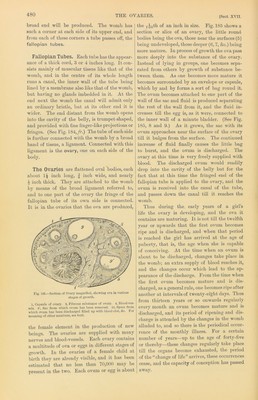
![THE OVARIES. [Sect. XVII. broad end will be produced. The womb has such a corner at each side of its upper end, and from each of these corners a tube passes ott', the fallopian tubes. Fallopian Tubes. Each tube luis the appear- ance of a thick cord, 3 or 4 inches long. It con- sists mainly of muscular tissue like that of the womb, and in the centre of its whole length runs a canal, the inner wall of the tube being lined by a membrane also like that of the womb, but having no glands imbedded in it. At the end next the womb the canal will admit only an ordinary bristle, but at its other end it is wider. The end distant from the womb opens into the cavity of the belly, is trumpet-shaped, and provided with fine finger-like projections or fringes. (See Fig. 184,/r.) The tube of each side is further connected with the womb by a broad band of tissue, a ligament. Connected with this ligament is the ovary, one on each side of the body. The Ovaries are flattened oval bodies, each about 1^ inch long, | inch wide, and nearly 4 inch thick. They are attached to the womb by means of the broad ligament referred to, and to one part of the ovary tlie fringe of the fallopian tube of its own side is connected. It is in the ovaries that the ova are produced. Fig. 185.—Section of Ovary magnified, showing ova in various stages of growth. 1, Capsule of ovary. 2, Fibrous substance of ovary. 4, P.lood-ves- scls. 9', Sac from which ovum has been removed. 10, Space from which ovum has been discharged filled up with blood-clot, &c. For meaning of other numbers, see text. the female element in the production of new beings. The ovaries are supplied with many nerves and blood-vessels. Each ovary contains a multitude of ova or eggs in different stages of growth. In the ovaries of a female child at birth they are already visible, and it has been estimated that no less than / 0,000 may be present in the two. Each ovum or egg is about the of an inch in size. Fig. 185 shows a section or slice of an ovary, the little round bodies being the ova, those near the surfaces (5) being undeveloped, those deeper (G, 7, &c.) being more mature. In process of growth the ova pass more deeply into the substance of the ovary. Instead of lying in groups, one becomes sepa- rated from others by growth of substance be- tween them. As one becomes more mature it becomes surrounded by an envelope or capsule, which by and by forms a sort of bag round it. The ovum becomes attached to one part of the wall of the sac and fluid is produced separating the rest of the wall from it, and the fluid in- creases till the egg is, as it were, connected to the inner wall of a minute bladder. (See Fig. 185, 8 and 9.) As it grows, the sac with its ovum approaches near the surface of the ovary till it bulges from the surface. The continued increase of fluid finally causes the little bag to burst, and the ovum is discliarged. The ovary at this time is very freely su]:>plied with blood. The discharged ovum would readily drop into the cavity of the belly but for the fact that at this time the fringed end of the fallopian tube is api)lied to the ovary, and the ovum is received into the canal of the tube, and passes down the canal till it reaches the womb. T1 lus during the. eaily years of a girl’s life the ovary is developing, and the ova it contains are maturing. It is not till the twelfth year or ui:)wards that the first ovum becomes ripe and is discharged, and when that period is reached the girl has anaved at the age of puberty, that is, the age when she is capable of conceiving. At the time when an ovum is about to be dischaiged, changes take place in the womb; an extra supply of blood reaches it, and the changes occur which lead to the ap- pearance of the discharge. Fi om the time when the fii’st ovum becomes mature and is dis- charged, as a general rule, one becomes ripe after another at intervals of twenty-eight days. Thus from thirteen years or so onwards regularly every month an ovvim becomes mature and is discharged, and its period of ripening and dis- charge is attended by the changes in the womb alluded to, and so there is the periodical occur- rence of the monthly illness. For a certain number of years—up to the age of forty-five or thereby—these changes regularly take place till the organs become exhausted, the period of the “change of life” arrives, the.se occurrences cease, and the capacity of conception has passed away.](https://iiif.wellcomecollection.org/image/b28124674_0001_0552.jp2/full/800%2C/0/default.jpg)