Volume 1
The household physician : a family guide to the preservation of health and to the domestic treatment of ailments and disease, with chapters on food and drugs and first aid in accidents and injuries / by J. McGregor-Robertson ; with an introduction by John G. McKendrick.
- M'Gregor-Robertson, J. (Joseph), 1858-1925
- Date:
- 1899
Licence: Public Domain Mark
Credit: The household physician : a family guide to the preservation of health and to the domestic treatment of ailments and disease, with chapters on food and drugs and first aid in accidents and injuries / by J. McGregor-Robertson ; with an introduction by John G. McKendrick. Source: Wellcome Collection.
557/602 (page 485)
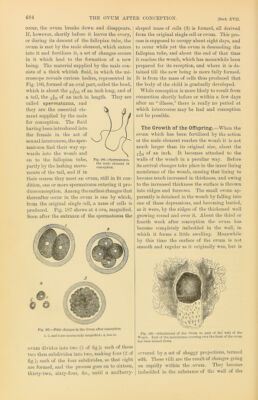
![GROWTH OF OFFSPRING IN THE WOMB. womb, which completely surrounds the ovum, and thus an intimate connection is effected be- tween the body of the mother and the growing offspring. At this period the condition of things is represented in Fig. 188, where the ovum with the shaggy projections of its own lining mem- brane is shown resting on the wall of the womb, which lias grown up around it so as com- pletely to surround and cover it. The ovum is thus shut u]D in a little chamber in the wall of the womb, and is shut off from the cavity of that organ. In the early pei'iod of its formation the new being is called an embryo, and in the later period before birth it is called a feet us. It is evident from Fig. 188 that as the em- bryo grows the swelling in the wall of the womb will grow larger and larger, and will gradually encroach on the space belonging to the cavity of the womb, until at length, with increased growth, the part of the wall which covers over the embryo will bulge right across to the opposite side, will, in fact, come into con- tact all round with the rest of the wall of the womb, and will become merged into it. This happens after the second month of pregnancy. The shaggy projections, that have been men- tioned as growing out from the wall of the ovum, undergo increased growth at tliat part of the ovum opposite to the part of the womb on which it rests, and at that j4ace blood-vessels come to occupy their intei’ioi’. At other parts of the ovum they shrink and disappear. Formation of Membranes and After-birth. —That pai’t of the wall of the womb on which the ovum rests undergoes special development, and as the result of the special growth on the part of both the womb and ovum at that place, a special structure is formed, called the placenta, by which tlie structures of the embryo and those of the mother come into intimate relationship, and in which the blood belonging to each comes into such close contact that exchanges of material can take ]dace between them. It is by means of the placenta that the nourishment of the growing offspring is obtained, it being a bond of union between offspring and mother, the agent through which nourishment is conveyed from the blood of the mother to the child. The pla- centa is also called the after-birth, from the fact that after the birth of the child it is sepa- rated and expelled from the womb. By the end of pregnancy it forms a disc-like mass, measuring 7^ inches across, | inch thick, and about 20 ounces in weight. Connected with it near the middle is the umbilical cord, by means of which the growing embryo is attached to the placenta. Running within the cord are two arteries which carry the blood from the embryo to the placenta. In the placenta the blood is distributed in large spaces, and comes into close communication with the blood of the mother, by means of which its purity and nourishing qualities are maintained. From the placenta the blood passes back along the cord in a vein to the embryo, to which it gives up the i-equisite siqjply of material for continued life and gi'owth. To return to the ovum. We have seen that after conception it divides into two cells, then into four, and so on, till a mass of cells is produced, which dispose themselves in such a way that a hollow sphere is formed. It is from the outer layer of this sphere that the shaggy projections arc thrown out which become connected with the part of the wall of the womb that has covered over the ovum, forming an outer membrane. On a part of the sphere the embryo begins to develop, and as it gi’ows the parts of the sphere beyond the place where it is developing rise up round it, and finally meet and close over it. Thus the embryo comes to be inclosed within a membranous sac of its own, called the amnion, while it maintains its connection with the parts beyond by a cord, the umbilical cord. As the embryo grows, fluid is formed within the sac, and thus the embryo as early as the second month is floating in fluid contained within a sac, and connected with the wall of the mother’s womb by means of a cord and the placenta. With further accumulation of fluid the amnion enlarges till it comes into contact with the outer membrane already mentioned, with which it becomes fused. So in the later stages of pregnancy the foetus is freely movable in a mass of liquid contained within a large sac formed of the blended membranes, and is sus- pended in the liquid by the cord, the other end of which is attached to the placenta, which is in close connection with the wall of the womb, the womb itself being comjfletely filled by the sac and its contents. In the course of labour the membranes are ruptured and the liquid escapes, in common talk “ the waters break.” Progress of Growth at different months. —In the course of the third month of preg- nancy the ovum, with its growing embryo in- closed within its membranes and floating in the fluid, comes to occu]>y the whole cavity of the womb. As the embryo continues growing the womb must needs enlarge with it. After the end of the third month of preg-](https://iiif.wellcomecollection.org/image/b28124674_0001_0557.jp2/full/800%2C/0/default.jpg)