Volume 1
The household physician : a family guide to the preservation of health and to the domestic treatment of ailments and disease, with chapters on food and drugs and first aid in accidents and injuries / by J. McGregor-Robertson ; with an introduction by John G. McKendrick.
- M'Gregor-Robertson, J. (Joseph), 1858-1925
- Date:
- 1899
Licence: Public Domain Mark
Credit: The household physician : a family guide to the preservation of health and to the domestic treatment of ailments and disease, with chapters on food and drugs and first aid in accidents and injuries / by J. McGregor-Robertson ; with an introduction by John G. McKendrick. Source: Wellcome Collection.
567/602 (page 495)
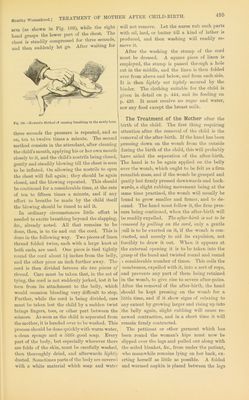
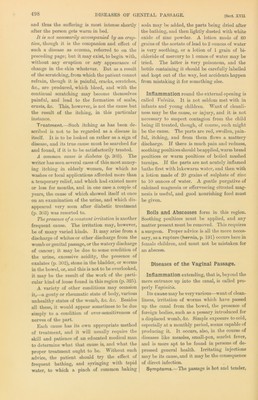
![Health, womanhood., TREATMENT OF MOTHER AFTER CHILD-BIRTH. arm (as shown in Fig. 189), while the right hand grasps the lower part of the chest. The chest is steadily compressed for three seconds, and then snddenly let go. After waiting for Fig. 189.—Howard’s Jlethod of causing breathing in the newly bom. ] three seconds the pressure is repeated, and so on, ten to twelve times a minute. The second method consists in the attendant, after cleaning the child’s mouth, applying his or her OAvn mouth closely to it, and the child’s nostrils being closed, gently and steadily blowing till the chest is seen to be inflated. On allowing the nostrils to open the chest will fall again; they should be again closed, and the blowing repeated. This should be continued for a considerable time, at the rate of ten to fifteen times a minute, and if any eflfort to breathe be made by the child itself the blowing should be timed to aid it. In ordinary cii'cumstances little effort is needed to excite breathing beyond the slapping, &c., already noted. All that remains to be done, then, is to tie and cut the coi’d. This is done in the following way. Two pieces of linen thread folded twice, each with a large knot at both ends, are used. One piece is tied tightly round the cord about 1^ inches from the belly, and the other piece an inch further away. The cord is then divided between the two 'pieces of thread. Care must be taken that, in the act of tying, the cord is not suddeidy jerked, lest it be torn from its attachment to the belly, which would occasion bleeding very difficult to stop. Further, while the cord is being divided, care must be taken lest the child by a sudden twist brings fingers, toes, or other part between the scissors. As soon as the child is separated from the mother, it is handed over to be washed. This process should be done quickly with warm water, a clean sponge and a little good soap. Every part of the body, but especially wherever there are folds of the skin, must be carefully washed, then thoroughly dried, and afterwards lighthj dusted. Sometimes parts of the body are covered with a white material which soap and water will not remove. Let the nurse rub such parts with oil, lard, or butter till a kind of lather is produced, and then washing will readily re- move it. After the washing the stump of the cord must be dressed. A square piece of linen is employed, the stump is passed through a hole cut in the middle, and the linen is then folded over from above and below, and from each side. It is then lightly not tightly secured by the binder. The clothing suitable for the child is given in detail on p. 444, and its feeding on p. 438. It must receive no sugar and water, nor any food except the breast milk. The Tpeatment of the Mother after the birth of the child. The first thing requiring attention after the removal of the child is the removal of the after-birth. If the hand has been pressing down on the womb from the outside during the birth of the child, this will probably have aided the separation of the after-birth. The hand is to be again applied on the belly over the womb, which ought to be felt as a firm roundish mass, and if the womb be grasped and gently but firmly pressed downwards and back- wards, a slight rubbing movement being at the same time practised, the womb will usually be found to grow smaller and firmer, and to de- scend. The hand must follow it, the firm pres- sure being continued, Avhen the after-birth will be readily expelled. The after-birth is not to be removed by pidling on the cord, only a gentle pull is to be exerted on it, if the womb is con- cracted, and merely to aid its expulsion, not forcibly to draw it out. When it appears at the external opening it is to be taken into the grasp of the hand and twisted round and round i considerable number of times. This coils the nembranes, expelled with it, into a sort of rope, and prevents any part of them being retained in the womb, to give rise to severe after-pains. After the removal of the after-birth, the hand should be kept pressing on the womb for a little time, and if it show signs of relaxing to any extent by growing larger and rising up into the belly again, slight rubbing will cause re- newed contraction, and in a short time it will remain firmly contracted. The petticoat or other garment which has been round the woman’s hips must now be slipped over the legs and pulled out along with the soiled blanket, &c., from under the patient, who meanwhile remains lying on her back, ex- erting herself as little as possible. A folded and warmed napkin is placed bet-ween the legs](https://iiif.wellcomecollection.org/image/b28124674_0001_0567.jp2/full/800%2C/0/default.jpg)