Licence: Public Domain Mark
Credit: Principles of forensic medicine / by William A. Guy and David Ferrier. Source: Wellcome Collection.
Provider: This material has been provided by the Royal College of Physicians of Edinburgh. The original may be consulted at the Royal College of Physicians of Edinburgh.
70/742 page 40
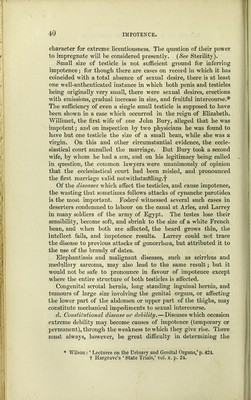
![character for extreme licentiousness. The question of their power to impregnate will he considered presently. (See Sterility). Small size of testicle is not sufficient ground for inferring impotence; for though there are cases on record in which it has coincided with a total absence of sexual desire, there is at least one well-authenticated instance in which both penis and testicles being originally very small, there were sexual desires, erections with emissions, gradual increase in size, and fruitful intercourse.* The sufficiency of even a single small testicle is supposed to have been shown in a case which occurred in the reign of Elizabeth. Willimet, the first wife of one John Bury, alleged that he was impotent; and on inspection by two physicians he was found to have hut one testicle the size of a small bean, while she was a virgin. On this and other circumstantial evidence, the eccle- siastical court annulled the marriage. But Bury took a second wife, by whom he had a son, and on his legitimacy being called in question, the common lawyers were unanimously of opinion that the ecclesiastical court had been misled, and pronounced the first marriage valid notwithstanding.']' Of the diseases which affect the testicles, and cause impotence, the wasting that sometimes follows attacks of cynanche parotidea is the most important. Fodere witnessed several such cases in deserters condemned to labour on the canal at Arles, and Larrey in many soldiers of the army of Egypt. The testes lose their sensibility, become soft, and shrink to the size of a white French bean, and when both are affected, the beard grows thin, the intellect fails, and impotence results. Larrey could not trace the disease to previous attacks of gonorrhoea, but attributed it to the use of the brandy of dates. Elephantiasis and malignant diseases, such as scirrhus and medullary sarcoma, may also lead to the same result; but it would not be safe to pronounce in favour of impotence except where the entire structure of both testicles is affected. Congenital scrotal hernia, long standing inguinal hernia, and tumours of large size involving the genital organs, or affecting the lowTer part of the abdomen or upper part of the thighs, may constitute mechanical impediments to sexual intercourse. d. Constitutional disease or debility.—Diseases which occasion extreme debility may become causes of impotence (temporary or permanent), through the weakness to which they give rise. There must always, however, be great difficulty in determining the * Wilson: ‘ Lectures on the Urinary and Genital Organs,’ p. 424. f Hargrave’s ‘ State Trials,’ vol. x. p. 24.](https://iiif.wellcomecollection.org/image/b2196516x_0070.jp2/full/800%2C/0/default.jpg)