Plant life and structure / by Dr. E. Dennert [tr. from the German by Clara L. Skeat].
- Eberhard Dennert
- Date:
- 1900
Licence: In copyright
Credit: Plant life and structure / by Dr. E. Dennert [tr. from the German by Clara L. Skeat]. Source: Wellcome Collection.
49/134
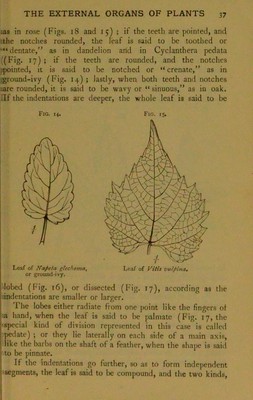
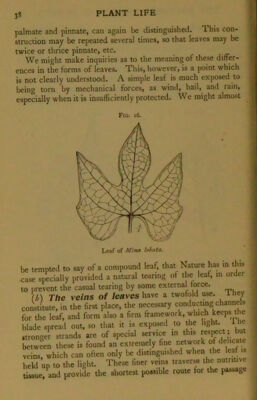
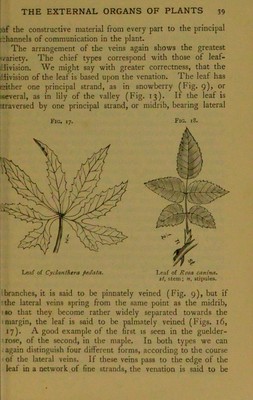
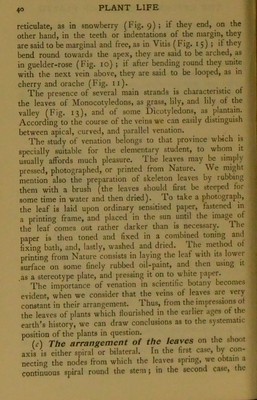
![.as in rose (Figs. 18 and 15) ; if the teeth are pointed, and the notches rounded, the leaf is said to be toothed or '■“dentate,” as in dandelion and in Cyclanthera pedata (Fig. 17); if the teeth are rounded, and the notches ipointed, it is said to be notched or “ crenate,” as in ^ground-ivy (Fig. 14) ; Jastly, when both teeth and notches ..are rounded, it is said to be wavy or “ sinuous,” as in oak. ilf the indentations are deeper, the whole leaf is said to be Fig. 14. Leaf of Napeta glechoma, or ground-ivy. Fig. 15. Leaf of Vitis vulpina. j lobed (Fig. 16), or dissected (Fig. 17), according as the l indentations are smaller or larger. The lobes either radiate front one point like the fingers of ’ a hand, when the leaf is said to be palmate (Fig. 17, the j special kind of division represented in this case is called j pedate) ; or they lie lateral ly on each side of a main axis, ] like the barbs on the shaft of a feather, when the shape is said I to be pinnate. If the indentations go further, so as to form independent i segments, the leaf is said to Ire compound, and the two kinds,](https://iiif.wellcomecollection.org/image/b28092843_0049.jp2/full/800%2C/0/default.jpg)
 No text description is available for this image
 No text description is available for this image
 No text description is available for this image