Treatise on human physiology : For the use of students & practitioners of medicine / By Henry C. Chapman. Illustrated with 595 engravings.
- Henry Cadwalader Chapman
- Date:
- 1899
Licence: Public Domain Mark
Credit: Treatise on human physiology : For the use of students & practitioners of medicine / By Henry C. Chapman. Illustrated with 595 engravings. Source: Wellcome Collection.
Provider: This material has been provided by the Augustus C. Long Health Sciences Library at Columbia University and Columbia University Libraries/Information Services, through the Medical Heritage Library. The original may be consulted at the the Augustus C. Long Health Sciences Library at Columbia University and Columbia University.
34/934 (page 28)
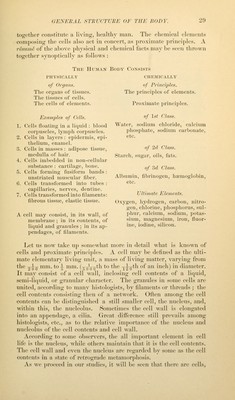
![CHAPTER I. GENERAL STRUCTURE OF THE BODY, PHYSICALLY AND CHEMICALLY. Before taking up the study of tlio functions, specifically, it will be well to consider, from a general point of view, of what the human body consists, physically and chemically speaking, to obtain some general knowledge of its organization, of which the functions are the living expression. As is known to every one, the human body, like that of a do- mestic animal, is made up of skin, muscles, bone ; of various viscera, such as the heart, lungs, liver, stomach ; of nerves, arteries, etc. The old anatomists busied themselves almost entirely with the description of such organs, their number, size, color, relative posi- tion, etc. This kind of study may be said to have culminated in Cuvier, who, as regards the exactness, extent, and variety of his knowledge, stands without a rival as an anatomist. If, however, any one organ is examined somewhat closely, it will be found to be far from homogeneous. Thus the stomach consists of several tissues, mucous, fibrous, muscular, etc.; the heart, of muscular, connective, adipose, nervous tissue, etc. Such tissues, combined in greater or less proportions, make up the different organs of which the body is composed ; the same tissue, for example, the connective, being found in different organs, just as the substance wood may be applied to making a chair, sofa, bed, or bookcase furnishing a room. The investigation of the tissues, the creation of, histology, is due to the genius of Bichat. If now any tissue be studied in detail, it (;an be still further resolved into simpler ultimate physical elements or what are commonly called cells, or their modifications. This last analysis was made by Schleiden and Schwann. Through the prog- ress of organic chemistry it has also become possible to state, with tolerable accuracy, of what the body is composed chemically. When the analysis is a proximate one, the result gives such principles as water, common salt, salts of lime; starch, sugar, fat; albumin, casein, etc. These principles exist as such in the human body, and are called ])roximate principles, b('ing the result of a proximate analysis. If now these principles be analyzed, they will be found to consist of hydrogen, oxygen, sodium, chlorine, carbon, nitrogen, phosphorus, etc. In this way it is shown that the human body consists, ultimately, of the ordinary chemical elements. A human being then consists, ultimately, of myriads of cells composed of the ordinary chemical elements. Certain cells form tissues, certain tis- sues act together as organs, and the organs harmoniously working](https://iiif.wellcomecollection.org/image/b21226131_0034.jp2/full/800%2C/0/default.jpg)