Treatise on human physiology : For the use of students & practitioners of medicine / By Henry C. Chapman. Illustrated with 595 engravings.
- Henry Cadwalader Chapman
- Date:
- 1899
Licence: Public Domain Mark
Credit: Treatise on human physiology : For the use of students & practitioners of medicine / By Henry C. Chapman. Illustrated with 595 engravings. Source: Wellcome Collection.
Provider: This material has been provided by the Augustus C. Long Health Sciences Library at Columbia University and Columbia University Libraries/Information Services, through the Medical Heritage Library. The original may be consulted at the the Augustus C. Long Health Sciences Library at Columbia University and Columbia University.
35/934 (page 29)
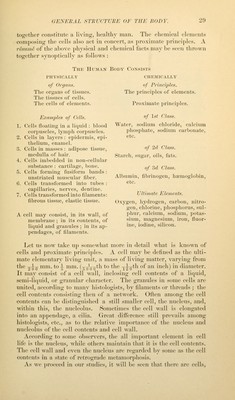
![together constitute a living, healthy man. The chemical elements composing the cells also act in concert, as proximate principles. A resume of the above physical and chemical facts may be seen thrown together synoptically as follows : The Human Body Consists PHYSICALLY of Organs. The organs of tissues. The tissues of cells. The cells of elements. Examples of Cells. 1. Cells floating in a liquid : blood corpuscles, lymph corpuscles. 2. Cells in layers : epidermis, epi- thelium, enamel. 3. Cells in masses : adipose tissue, medulla of hair. 4. Cells imbedded in non-cellular substance : cartilage, bone. 5. Cells forming fusiform bands: unstriated muscular fiber. G. Cells transformed into tubes : capillaries, nerves, dentine. 7. Cells transformed into filaments: fibrous tissue, elastic tissue. A cell may consist, in its wall, of membrane ; in its contents, of liquid and granules ; in its ap- pendages, of filaments. CHEMICALLY of Principles. The principles of elements. Proximate principles. of 1st Class. Water, sodium chloride, calcium phosphate, sodium carbonate, etc. of •2d Class. Starch, sugar, oils, fats. of 3cl Class. Albumin, fibrinogen, hsemoglobin, etc. Ultimate Elements. Oxygen, hydrogen, carbon, nitro- gen, chlorine, phosphorus, sul- phur, calcium, sodium, potas- sium, magnesium, iron, fluor- ine, iodine, silicon. Let us now take up somewhat more in detail what is known of cells and proximate princi])les. A cell may be defined as the ulti- mate elementary living unit, a mass of living matter, varying from the Tj-i-Q mm. to |- mm. (-^Jg-Q-th to the y^-g-th of an inch) in diameter. It may consist of a cell wall, inclosing cell contents of a liquid, semi-liquid, or granular character. The granules in some cells are united, according to many histologists, by filaments or threads ; the cell contents consisting then of a network. Often among the cell contents can be distinguished a still smaller cell, the nucleus, and, within this, the nucleolus. Sometimes the cell wall is elongated into an appendage, a cilia. Great diflcrence still prevails among histologists, etc., as to the relative importance of the nucleus and nucleolus of the cell contents and cell Avail. According to some observers, the all important element in cell life is the nucleus, Avhile others maintain that it is the cell contents. The cell wall and even the nucleus are regarded by some as the cell contents in a state of retrograde metamorphosis. As we proceed in our studies, it will be seen that there are cells,](https://iiif.wellcomecollection.org/image/b21226131_0035.jp2/full/800%2C/0/default.jpg)