Treatise on human physiology : For the use of students & practitioners of medicine / By Henry C. Chapman. Illustrated with 595 engravings.
- Henry Cadwalader Chapman
- Date:
- 1899
Licence: Public Domain Mark
Credit: Treatise on human physiology : For the use of students & practitioners of medicine / By Henry C. Chapman. Illustrated with 595 engravings. Source: Wellcome Collection.
Provider: This material has been provided by the Augustus C. Long Health Sciences Library at Columbia University and Columbia University Libraries/Information Services, through the Medical Heritage Library. The original may be consulted at the the Augustus C. Long Health Sciences Library at Columbia University and Columbia University.
39/934 (page 33)
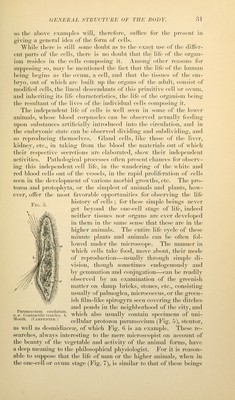
![blast, others the hypobhist, and between these two layers a third appears, the mesoblast. The modification of the cells and the fnrther development of these three layers will be considered when we take up the subject of reproduction. It will be seen then that throuo;]i the processes in- cidental to development, cells often lose their originally round form, becoming sometimes flattened or scale-like, and often of a prismatic and columnar shape. Sometimes the cells float free in a liquid, like the blood corpuscles ; or they may arrange themselves in layers, like those of the enamel; or in masses, as seen in the medulla of hairs. They may be imbedded in a solid non-cellular matrix, as in carti- lage. Cells are sometimes flattened into bands, as in the unstriated Fig. 9. Development of Protococcus pluvialis. (Caepentek.) muscular fiber, or a number are, through the dissolution of their adjacent walls, metamorphosed into tubes, of which the capillaries and dentine are examples, or they may be converted into fibrous tissue. These modifications are shown synoptically arranged in the table giving the physical constituents of the body. The va- rious substances elaborated by cells in diiferent parts of the adult economy will be more appropriately considered as the functions of the organs are taken up. It will be seen that the life of the body is, therefore, the resultant life of the cells composing it; that the body is a living republic of cells. Let us now return to the chemical composition of the body, or of the cells of which it consists. We have seen that the human body consists of chemical elements acting as proximate principles. A proximate principle may be defined as a principle, simple or compound, which exists and acts as such in the human body. Thus, sodium chloride is a proximate principle. Neither the rare metal sodium, nor the offensive greenish gas chlorine, however, are proximate principles, for they do not exist or act as such in the body. Calcium phosphate is an example of a proximate principle ; but the metal calcium, and the phosphoric acid, not existing or act- ing separately, as calcium and phosphoric acid, in the body, cannot 3](https://iiif.wellcomecollection.org/image/b21226131_0039.jp2/full/800%2C/0/default.jpg)