Treatise on human physiology : For the use of students & practitioners of medicine / By Henry C. Chapman. Illustrated with 595 engravings.
- Henry Cadwalader Chapman
- Date:
- 1899
Licence: Public Domain Mark
Credit: Treatise on human physiology : For the use of students & practitioners of medicine / By Henry C. Chapman. Illustrated with 595 engravings. Source: Wellcome Collection.
Provider: This material has been provided by the Augustus C. Long Health Sciences Library at Columbia University and Columbia University Libraries/Information Services, through the Medical Heritage Library. The original may be consulted at the the Augustus C. Long Health Sciences Library at Columbia University and Columbia University.
42/934 (page 36)
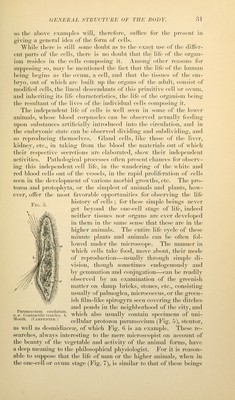
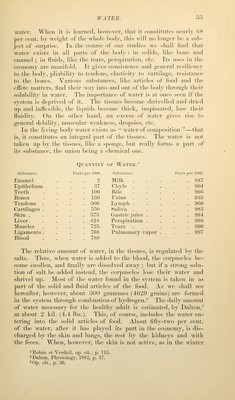
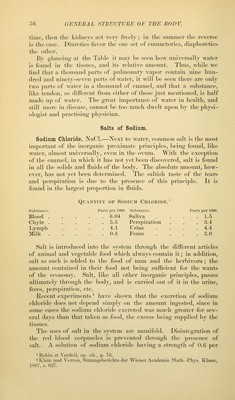
![time, then the kidneys act very freely; in the summer the reverse is the case. Diuretics favor the one set of emunctories, diaphoretics the other, Bv o;kincino; at the Table it may be seen how universally water is found in the tissues, and its relative amount. Thus, while we find that a thousand parts of pulmonary vapor contain nine hun- dred and ninety-seven parts of water, it Avill be seen there are only two parts of water in a thousand of enamel, and that a substance, like tendon, so different from either of those just mentioned, is half made up of water. The great importance of water in health, and still more in disease, cannot be too much dwelt u})on by the physi- ologist and practising physician. Salts of Sodium. Sodium Chloride, XaCl,—Next to water, common salt is the most important of the inorganic proximate principles, being found, like water, almost universally, even in the ovum. With the exception of the enamel, in which it has not yet been discovered, salt is found in all the solids and fluids of the body. The absolute amount, how- ever, has not yet been determined. The saltish taste of the tears and ]>erspiration is due to the presence of this principle. It is found in the largest proportion in fluids. Quantity of Sodium Chloride/ Substauce. Parts per 1000. Substance. Parts per 1000. Blood 6.04 Saliva .... 1.5 Chyle ..... 5.3 Perspiration . , , 3.4 Lymph , . . .4.1 Urine .... 4.4 Milk 0.8 Feces . . . .3.0 Salt is introduced into the system through the different articles of animal and vegetable food which always contain it; in addition, salt as such is added to the food of man and the herbivora; the amount contained in their food not being sufficient for the wants of the economy. Salt, like all other inorganic principles, passes ultimately through the body, and is carried out of it in the urine, feces, perspiration, etc. Recent experiments - have shown that the excretion of sodium chloride does not depend simply on the amount ingested, since in some cases the sodium chloride excreted was much greater for sev- eral days than that taken as food, the excess being supplied by the tissues. The uses of salt in the system are manifold. Disintegration of the red blood corpuscles is prevented through the presence of salt. A solution of sodium chloride having a strength of 0.6 per iK()l)in et Verdeil, op. cit., p. 76. 2 Klein und \'eiTon, Sitzungsbericlite der Wiener Academie ]S[ath.-Phv.s. Klasse, 1807, s. 627.](https://iiif.wellcomecollection.org/image/b21226131_0042.jp2/full/800%2C/0/default.jpg)