Teetotalism in relation to chemistry and physiology : the substance of a lecture delivered in the Music Hall, Leeds, April 9th, 1851, under the auspices of the Temperance Society / by Dr. Frederick R. Lees.
- Frederic Richard Lees
- Date:
- [between 1800 and 1899?]
Licence: Public Domain Mark
Credit: Teetotalism in relation to chemistry and physiology : the substance of a lecture delivered in the Music Hall, Leeds, April 9th, 1851, under the auspices of the Temperance Society / by Dr. Frederick R. Lees. Source: Wellcome Collection.
11/12 (page 11)
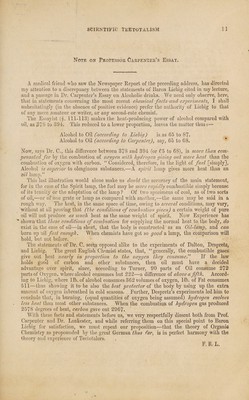
![Note on Professor Carpenter’s Essay, A medical friend who saw the Newspaper Report of the preceding address, has directed my attention to a discrepancy between the statements of Baron Liebig cited in my lecture, and a passage in Dr. Carpenter’s Essay on Alcoholic drinks. We need only observe, here, that in statements concerning the most recent chemical facts and experiments, I shall unhesitatingly (in the absence of positive evidence) prefer the authority of Liebig to that of auv mere .amateur or writer, or any second-rate chemist. The Essayist (§. 111-113) makes the heat-producing power of alcohol compared with oil, as 378 to 394. This reduced to a lower proportion, leaves the matter thus;— Alcohol to Oil (according to Liebig) is as 65 to 87. Alcohol to Oil (according to Carpenter), say, 65 to 68* Now, says Dr. C., this difference between 878 and 394 (or 65 to 68), is more than com= pensated for by the combustion of oxygen with hydrogen giving out more heat than the combustion of oxygen with carbon. “Considered, therefore, in the light of fuel [simply], Alcohol is superior to oleaginous substances.—A spirit lamp gives more heat than an oil lamp.” This last illustration would alone make us doubt the accuracy of the main statement, for in the case of the Spirit lamp, the fuel may be more rapidly combustible simply because of its tenuity or the adaptation of the lamp P Of two specimens of coal, as of two sorts of oil,—or of one grate or lamp as compared with another,—the same may be said in a rough way. The heat, in the same space of time, owing to several conditions, may vary, without at all proving that (the conditions of combustion given) a certain weight of pure oil will not produce as much heat as the same weight of spirit. Now Experience has '■ shown that these conditions of combustion for supplying the normal heat to the body, do exist in the case of oil—in short, that the body is constructed as an Oil-lamp, and can burn up oil fast enough. When chemists have got so good a lamp, the comparison will hold, but not before. The statements of Dr. C. seem opposed alike to the experiments of Dalton, Despretz, and Liebig. The great English Chemist states, that, “generally, the combustible gases give out heat nearly in proportion to the- oxygen they consumer If the law holds good of carbon and other substances, then oil must have a decided advantage over spirit, since, according to Turner, 90 parts of Oil consume 272 parts of Oxygen, vrhere alcohol consumes hut 222—a difference of above a fifth. Accord¬ ing to Liebig, where lib. of alcohol consumes 362 volumes of oxygen, lib. of Eat consumes 511—thus showing it to be also the best protector of the body by using up the extra amount of oxygen inbreathed in cold seasons. Further, Despretz’s experiments led him to conclude that, in burning, (equal quantities of oxygen being assumed) hydrogen evolves less heat than most other substances. When the combustion of hydmogen gas produced 2578 degrees of heat, carbon gave out 2967. With these facts and statements before us, we very respectfully dissent both from Prof. Carpenter and Dr. Lankester, and while referring them on this special point to Baron Liebig for satisfaction, we must repeat our proposition—that the theory of Organic Chemistry as propounded by the great German thus far, is in perfect harmony with the theory and experience of Teetotalers. , F. ILL.](https://iiif.wellcomecollection.org/image/b30478534_0011.jp2/full/800%2C/0/default.jpg)