Lunacy practice / by N. Arthur Heywood and Arnold S. Massey.
- Heywood, N. Arthur (Nathaniel Arthur)
- Date:
- 1900
Licence: In copyright
Credit: Lunacy practice / by N. Arthur Heywood and Arnold S. Massey. Source: Wellcome Collection.
Provider: This material has been provided by King’s College London. The original may be consulted at King’s College London.
94/226 (page 80)
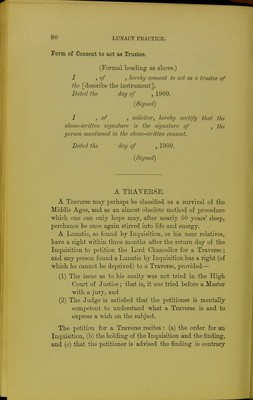
![Form of Consent to act as Trustee. (Formal heading as above.) I , of , hereby consent to act as a trustee of the [desoribe the instrument]. Bated the day of , 1900. (Signed) I , of , solicitor, hereby certify that the above-written signature is the sir/nature of , the X>crson mentioned in the abovc-ioritten consent. Bated the day of , 1900. {Signed) A TEAVEESE. A Traverse may perhaps be classified as a survival of the Middle Ages, and as an almost obsolete method of procedure which one can only hope may, after nearly 50 years' sleep, perchance be once again stirred into life and energy. A Lunatic, so found by Inquisition, or his near relatives, have a right within three months after the return day of the Inquisition to petition the Lord Chancellor for a Traverse; and any person found a Lunatic by Inquisition has a right (of which he cannot be deprived) to a Traverse, provided— (1) The issue as to his sanity was not tried in the High Court of Justice; that is, it was tried before a Master with a jury, and (2) The Judge is satisfied that the petitioner is mentally competent to understand what a Traverse is and to express a wish on the subject. The petition for a Traverse recites : (a) the order for an Inquisition, (b) the holding of the Inquisition and the finding, and (c) that the petitioner is advised the finding is contrary](https://iiif.wellcomecollection.org/image/b21294604_0094.jp2/full/800%2C/0/default.jpg)