On the subject of priority in the medication of the larynx and trachea / by Horace Green.
- Horace Green
- Date:
- 1854
Licence: Public Domain Mark
Credit: On the subject of priority in the medication of the larynx and trachea / by Horace Green. Source: Wellcome Collection.
12/20 page 10
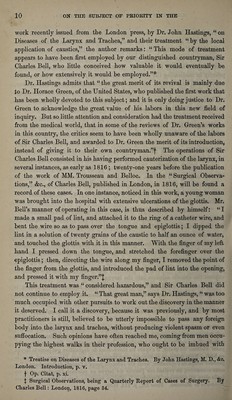
![work recently issued from the London press, by Dr. John Hastings, “ on Diseases of the Larynx and Trachea,” and their treatment “ by the local application of caustics,” the author remarks: “ This mode of treatment appears to have been first employed by our distinguished countryman, Sir Charles Bell, who little conceived how valuable it would eventually be found, or how extensively it would be employed.”* Dr. Hastings admits that “ the great merit of its revival is mainly due Jo Dr. Horace Green, of the United States, who published the first work that has been wholly devoted to this subject; and it is only doing justice to Dr. Green to acknowledge the great value of his labors in this new field of inquiry. But so little attention and consideration had the treatment received from the medical world, that in some of the reviews of Dr. Green’s works in this country, the critics seem to have been wholly unaware of the labors of Sir Charles Bell, and awarded to Dr. Green the merit of its introduction, instead of giving it to their own countryman”! The operations of Sir Charles Bell consisted in his having performed cauterization of the larynx, in several instances, as early as 1816 ; twenty-one years before the publication of the work of MM. Trousseau and Belloc. In the “ Surgical Observa¬ tions,” &c., of Charles Bell, published in London, in 1816, will be found a record of these cases. In one instance, noticed in this work, a young woman was brought into the hospital with extensive ulcerations of the glottis. Mr. Bell’s manner of operating in this case, is thus described by himself: “ I made a small pad of lint, and attached it to the ring of a catheter wire, and bent the wire so as to pass over the tongue and epiglottis; I dipped the lint in a solution of twenty grains of the caustic to half an ounce of water, and touched the glottis with it in this manner. With the finger of my left hand I pressed down the tongue, and stretched the forefinger over the epiglottis; then, directing the wire along my finger, I removed the point of the finger from the glottis, and introduced the pad of lint into the opening, and pressed it with my finger.”;]; This treatment was “ considered hazardous,” and Sir Charles Bell did not continue to employ it. “ That great man,” says Dr. Hastings, “ was too much occupied with other pursuits to work out the discovery in the manner it deserved. I call it a discovery, because it was previously, and by most practitioners is still, believed to be utterly impossible to pass any foreign body into the larynx and trachea, without producing violent spasm or even suffocation. Such opinions have often reached me, coming from men occu- pying the highest walks in their profession, who ought to be imbued with * Treatise on Diseases of the Larynx and Trachea. By John Hastings, M. D., <fcc. London. Introduction, p. v. f Op. Citat, p. xi. \ Surgical Observations, being a Quarterly Report of Cases of Surgery. By Charles Bell: London, 1816, page 34.](https://iiif.wellcomecollection.org/image/b30798656_0012.jp2/full/800%2C/0/default.jpg)

 No text description is available for this image
 No text description is available for this image
 No text description is available for this image