On the subject of priority in the medication of the larynx and trachea / by Horace Green.
- Horace Green
- Date:
- 1854
Licence: Public Domain Mark
Credit: On the subject of priority in the medication of the larynx and trachea / by Horace Green. Source: Wellcome Collection.
5/20 page 3
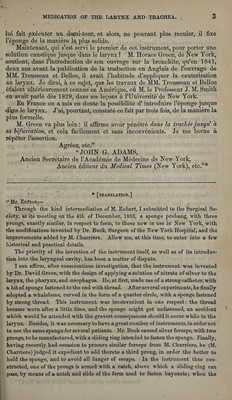
![lui fait executer un demi-tour, et alors, ne pouvant plus reculer, il fixe l’eponge de la maniere la plus solide. Maintenant, qui s’est servi le premier de cet instrument, pour porter une solution caustique jusque dans le larynx ? M. Horace Green, de New York, soutient, dans l’introduction de son ouvrage sur la broncbite, qu’en 1841, deux ans avant la publication de la traduction en Anglais de 1’ouvrage de MM. Trousseau et Belloc, il avait l’habitude d’appliquer la cauterization au larynx. Je dirai, a ce sujet, que les travaux de MM. Trousseau et Belloc et’aient ulterieurement connus en Amerique, ou M. le Professeur J. M. Smith, en avait parle des 1828, dans ses legons a l’Universite'de New York. En France on a mis en donte la possibility d’ introduire l’eponge jusque d%ns le larynx. J’ai, pourtant, constate ce fait par trois fois, de la maniere la plus formelle. M. Green va plus loin: il affirme avoir penetre dans la track ee jusqu* 1 a sa bifurcation, et cela facilement et sans inconvenients. Je me borne a repeter l’assertion. ■ • Agreez, etc.” “JOHN G. ADAMS, Ancien Secretaire de l’Academie de Medecine de New York, Ancien editeur du Medical Times (New York), etc.”* •' * [translation.] “Mr. EdItor— Through the kind intermediation of M. Robert, I submitted to the Surgical So¬ ciety, at its meeting on the 4th of December, 1853, a sponge probang, with three prongs, exactly similar, in respect to form, to those now in use in New York, with the modifications invented by Dr. Buck, Surgeon of the New York Hospital, and the improvements added by M. Charriere. Allow me, at this time, to enter into a few historical and practical details. The priority of the invention of the instrument itself, as well as of its introduc¬ tion into the laryngeal cavity, has been a matter of dispute. I can affirm, after conscientious investigation, that the instrument was invented by Dr. David Green, with the design of applying a solution of nitrate of silver to the larynx, the pharynx, and oesophagus. He, at first, made use of a strong catheter, with a bit of sponge fastened to the end with thread. After several experiments, he finally adopted a whalebone, curved in the form of a quarter-circle, with a sponge fastened by strong thread. This instrument was inconvenient in one respect: the thread became worn after a little time, and the sponge might get unfastened, an accident which would be attended with the gravest consequences should it occur while in the larynx. Besides, it was necessary to have a great number of instruments, in order not to use the same sponge for several patients. Mr. Buck caused silver forceps, with two prongs, to be manufactured, with a sliding ring intended to fasten the sponge. Finally, having recently had occasion to procure similar forceps from M. Charriere, he (M. Charriere) judged it expedient to add thereto a third prong, in order the better to hold the sponge, and to avoid all danger of escape. In the instrument thus con¬ structed, one of the prongs is armed with a catch, above which a sliding ring can pass, by means of a notch and slide of the form used to fasten bayonets; when the](https://iiif.wellcomecollection.org/image/b30798656_0005.jp2/full/800%2C/0/default.jpg)