[Report 1924] / Medical Officer of Health, Monmouthshire County Council.
- Monmouthshire County Council
- Date:
- 1924
Licence: Attribution 4.0 International (CC BY 4.0)
Credit: [Report 1924] / Medical Officer of Health, Monmouthshire County Council. Source: Wellcome Collection.
29/84 page 27
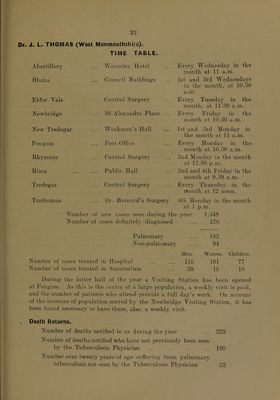
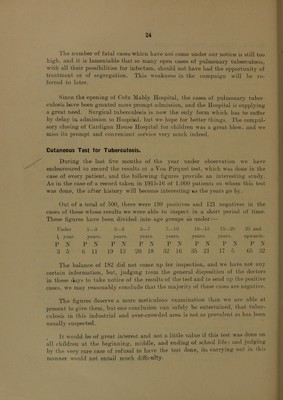
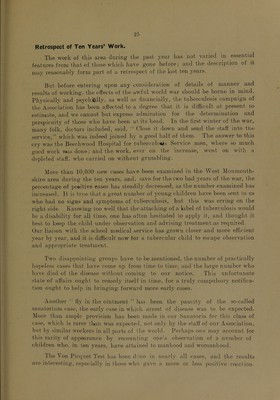
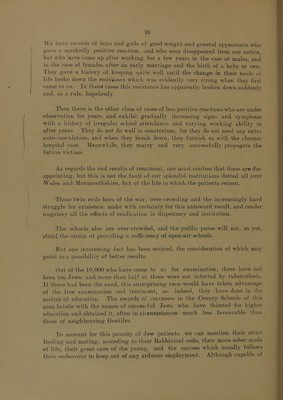
![carrying- great loads, these are usnally their own, and these get lighter as their pockets grow heather. One has never heard of a Jew coal miner in West Mon- nionthshire, and we probably never shall. 13nt this small incidence of tuberculosis amoaigst the Jews can be accounted for by the comparative absence of familial infection, due tO' strict marriage customs, and the resulting diminished possibility of heredity of seed or soil. A study of our case sheets compels one to conclude tliat heredity in tuber- culosis cannot be dismissed lightly, and that our incidence of tuberculosis would be lessened by a more strict marriage selection, and our resistance to infection by tuberculosis would, it is reasonable toi conclude, be strengthened by careful upbringing in infancy, followed by stringent care in the selection of animal food. With a view to remedying the ill effects of environment in the home the Association and the County Health Committee have endeavoured to set up After-Care Committees in the County, but the institution of such Committees has not been without its difficulties. After Care Work. In these days of democratic councils there is a strong feeling lagainst funds derived from private benevolence and allocated by charitable agencies, and in \ favour of Statutoi-y Care Committees of the Council for the pui'pose of T.B. care work. The Public Health (Tuberculosis) Act, 1921, gives power to County and County Borough Councils to make a Committee or Sub-Committee of the Council responsible for arrangements “ for the after-care of persons who have suffered from tuberculosis,” and for that purpose persons of special experience, not members of the Council, may be co-opted to the Committee, subject to a limitation as to the relative number of Council members and co-opted member's. Such Committees have been formed in all the districts of the L'ounty, and the foundation of these Committees has been the Infant Welfare and Maternity ( Committee, with persons representing various public bodies and interested in \ public healtb work added to it. Such Local Committees ha.ve met in all the districts in which our Visiting Stations for dispensary work are situated, and while each one readily endeavoured to do the work, it was with the understand- ing that the funds for the purpose should be statutoiy in origin and distribution. The voluntary and charitable form of after-care work did not meet with the 1 a])proval of tliose who attended the Committees, and, indeed, in an area, such as ^ West ^lonmouth, almost entirely industrial in character, very little success could be expec-.ted from this method of o])eration. In practically all the districts the resolution to do the tuberculosis work was passed subject to the provision of tlie necessaiy funds by the County or State, or both, and there tlie matter](https://iiif.wellcomecollection.org/image/b28861449_0031.jp2/full/800%2C/0/default.jpg)