Volume 1
The science and art of surgery : a treatise on surgical injuries, diseases, and operations / by John Eric Erichsen.
- John Eric Erichsen
- Date:
- 1895
Licence: Public Domain Mark
Credit: The science and art of surgery : a treatise on surgical injuries, diseases, and operations / by John Eric Erichsen. Source: Wellcome Collection.
Provider: This material has been provided by The University of Leeds Library. The original may be consulted at The University of Leeds Library.
162/1274 (page 130)
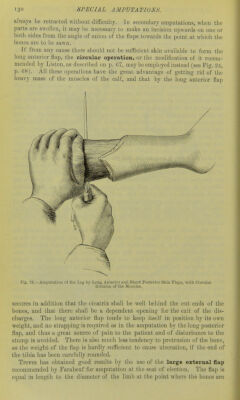
![always be retracted without difficulty. In secondary amputation.s, when the parts are swollen, it may lie necessary to make an incision upwards on one or both sides from the angle of union of the flaps towards the point at which the bones are to be sawn. If from any cause there should not be sufficient skin available to form the long anterio]' flap, the circular operation, or the modification of it recom- mended by Listen, as described on p. 07, may be employed instead (see Fig. 24, p. G8). All these operations have the great advantage of getting rid of the heavy mass of the muscles of the calf, and that by the long anterior flap Fig. 73.—Amputation of tlie Leg by Long Anterior inul Short Posterior Skin Flaps, with Circular Division of the Muscles. secures in addition that the cicatrix shall be well behind the cut ends of the bones, and that there shall be a dependent opening for the exit of the dis- charges. The long anterior flap tends to keep itself in position by its own weight, and no strapping is retjuired as in the amputation by the long posterior flap, and thus a great source of pain to the patient and of disturbance to the stump is avoided. There is also much less tendency to protrusion of the bone, as the weight of the flap is hardly sufficient to cause ulceration, if the end of the tibia has been carefully rounded. Treves has obtained good results by the use of the large external flap recommended by Farabeuf for amputation at the seat of election. The flap is equal in length to the diameter of the limb at the point where the bones are](https://iiif.wellcomecollection.org/image/b21510969_0001_0162.jp2/full/800%2C/0/default.jpg)