Volume 1
The science and art of surgery : a treatise on surgical injuries, diseases, and operations / by John Eric Erichsen.
- John Eric Erichsen
- Date:
- 1895
Licence: Public Domain Mark
Credit: The science and art of surgery : a treatise on surgical injuries, diseases, and operations / by John Eric Erichsen. Source: Wellcome Collection.
Provider: This material has been provided by The University of Leeds Library. The original may be consulted at The University of Leeds Library.
165/1274 (page 133)
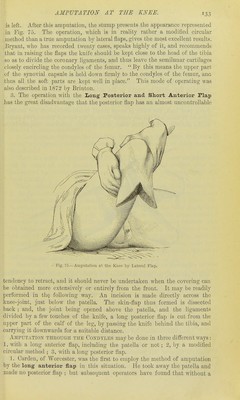
![is left. After this amputation, the stump presents the a]Dpearance represented in Fig. 75. The operation, which is in reality rather a modified circular method than a true amputation by lateral flaps, gives the most excellent results. Bryant, who has recorded twenty cases, speaks highly of it, and recommends that in raising the flaps the knife should be kept close to the head of the tibia so as to divide the coronary ligaments, and thus leave the semilunar cartilages closely encircling the condyles of the femur. By this means the upper part of the synovial capsule is held down firmly to the condyles of the femur, ana thus all the soft parts are kept well in place. This mode of operating was also described in 1872 by Brinton. 3. The operation with the Long Posterior and Short Anterior Flap has the great disadvantage that the posterior flap has an almost uncontrollable - Fig. 75.—Amputation at tlie Knee by Lateral Flap. tendency to retract, and it should never be undertaken when the covering can be obtained more extensively or entirely from the front. It may be readily performed in thg following way. An incision is made directly across the knee-joint, just below the patella. The skin-flap thus formed is dissected back ; and, the joint being opened above the patella, and the ligaments divided by a few touches of the knife, a long posterior flap is cut from the upper part of the calf of the leg, by passing the knife behind the tibia, and carrying it doAvnwards for a suitable distance. Amputation through the Condyles maybe done in three different ways: 1, with a long anterior flap, including the patella or not; 2, by a modified circular method ; 3, with a long posterior flap. 1. Garden, of Worcester, was the first to employ the method of amputation by the long anterior flap in this situation. Ife took away the patella and made no posterior flap ; but subsequent operators have found that without a](https://iiif.wellcomecollection.org/image/b21510969_0001_0165.jp2/full/800%2C/0/default.jpg)