Volume 1
The science and art of surgery : a treatise on surgical injuries, diseases, and operations / by John Eric Erichsen.
- John Eric Erichsen
- Date:
- 1895
Licence: Public Domain Mark
Credit: The science and art of surgery : a treatise on surgical injuries, diseases, and operations / by John Eric Erichsen. Source: Wellcome Collection.
Provider: This material has been provided by The University of Leeds Library. The original may be consulted at The University of Leeds Library.
285/1274 (page 253)
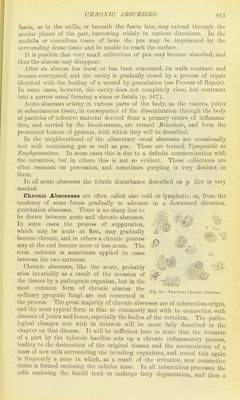
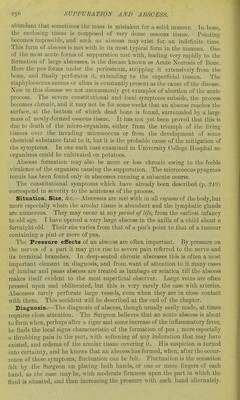
![CHRONIC ABSCESSES. fascia, as in the axilla, or beneath the fascia lata, may extend through the areolar planes of the part, burrowing widely in various directions. In the medulla or cancellous tissue of bone the pus may be imprisoned by the surrounding dense tissue and be unable to reach the surface. It is possible that very small collections of pus may become absorbed, and thus the abscess may disappear. After an abscess has burst or has been evacuated, its walls contract and become corrugated, and the cavity is gradually closed by a process of repair identical with the healing of a wound by granulation {see Process of Repair), In some cases, however, the cavity does not completely close, but contracts into a narrow canal forming a sinus or fistula (p. 267). Acute abscesses arising in various parts of the body, as the viscera, joints or subcutaneous tissue, in consequence of the dissemination through the body of particles of infective material derived from a primary centre of inflamma- tion, and carried by the blood-stream, are tenned Metastatic, and form the prominent feature of pyasmia, with which they will be described. In the neighbourhood of the alimentary canal abscesses are occasionally met with containing gas as well as pus. These are termed Tym]]anitic or Eiiqyhysematous. In some cases this is due to a definite communication with the intestines, but in others this is not so evident. These collections are often resonant on percussion, and sometimes gurgling is very distinct in them. In all acute abscesses the febrile disturbance described on p. 250 is very marked. Chronic ATjscesses are often called also cold or lymphatic, or, from the tendency of some forms gradually to advance in a downward direction, gravitation abscesses. There is no sharp line to be drawn between acute and chronic abscesses. In some cases the process of suppuration, which may be acute at first, may gradually become chronic, and in others a chronic process may at the end become more or less acute. The term subacute is sometimes applied to cases between the two extremes. Chronic abscesses, like the acute, probably arise invariably as a result of the invasion of the tissues by a pathogenic organism, but in the most common form of chronic abscess the ordinary pyogenic fungi are not concerned in the process. The great majority of chronic abscesses are of tuberculous origin, and the most typical form is that so commonly met with in connection with diseases of joints and bones, especially the bodies of the vertebrjB. The patho- logical changes met with in tubercle will be more fully described in the chapter on that disease. It will be sufficient here to state that the invasion of a part by the tubercle bacillus sets up a chronic inflammatory process, leading to the destruction of the original tissues and the accumulation of a mass of new cells surrounding the invading organisms, and round tliis again is frequently a zone in which, as a result of the irritation, new connec^tive tissue is formed enclosing the cellular mass. In all tuberculous processes the cells enclosing the bacilli tend to undergo fatty degeneration, and thus a •.■<>'::'?M.' Fig. !)2.—Pus from Chronic Abscess.](https://iiif.wellcomecollection.org/image/b21510969_0001_0285.jp2/full/800%2C/0/default.jpg)