Volume 1
The science and art of surgery : a treatise on surgical injuries, diseases, and operations / by John Eric Erichsen.
- John Eric Erichsen
- Date:
- 1895
Licence: Public Domain Mark
Credit: The science and art of surgery : a treatise on surgical injuries, diseases, and operations / by John Eric Erichsen. Source: Wellcome Collection.
Provider: This material has been provided by The University of Leeds Library. The original may be consulted at The University of Leeds Library.
95/1274 (page 63)
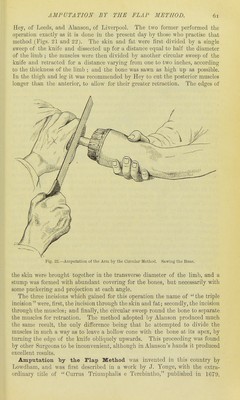
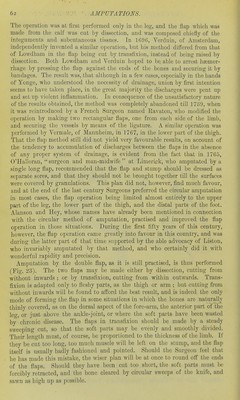
![The flap farthest from the great vessels, as that on the outer side of the thigh or arm, should be cut first. In making the inner flap, great care must be taken to wnd the point of tlie knife well round the bone, so as not to transfix and split the vessels, but to cut them as long as possible. As a general rule, the less loose muscle that is left on the stump, the better ; hence, where there is an Fig. 23.—Amput.ition of the Thigh. Antero-posterior Flap Operation. Flaps cut by Transfixion. equal thickness of soft parts round the l)one, as in the arm and thigh, the flaps should be cut short, well retracted, and the bone cleared by circular sweeps of the knife as high as necessary. The bone thus lies at the bottom of a deep hollow beyond the angle of junction of the flaps, and there is less chance of a conical stump being left. In cutting a flap from without inwards, it is of the greatest importance to remember that the edge of the knife must never be turned towards the under surface of the flap, but always towards the parts to be removed. After marking out the flap with the point of the knife, the Surgeon takes the edge of the skin between the finger and thumb of his left hand and raises it from the parts beneath. The ]iortion of the flap which is thus raised is therefore at right angles to the surface of the limb, and the knife must also be kept in ai similar direction, or its edge will be turned towards the base of the flap, and by scoring its under surface will greatly increase the danger of sloughing. The flap must be raised evenly across the limb, and one side must not be allowed to get in advance of the other. When bands of areolar tissue are seen passing from the flap to the parts beneath, the operator must divide these at the end that is attached to the parts to be removed. There should be no hurry about raising the flap by dissection, as under the influence of anajsthotics](https://iiif.wellcomecollection.org/image/b21510969_0001_0095.jp2/full/800%2C/0/default.jpg)