Volume 1
Cooley's Cyclopædia of practical receipts and collateral information in the arts, manufactures, professions, and trades, including medicine, pharmacy, and domestic economy : designed as a comprehensive supplement to the pharmacopœia and general book of reference for the manufacturer, tradesman, amateur, and heads of families.
- Cooley, Arnold J. (Arnold James)
- Date:
- 1892
Licence: Public Domain Mark
Credit: Cooley's Cyclopædia of practical receipts and collateral information in the arts, manufactures, professions, and trades, including medicine, pharmacy, and domestic economy : designed as a comprehensive supplement to the pharmacopœia and general book of reference for the manufacturer, tradesman, amateur, and heads of families. Source: Wellcome Collection.
24/916 (page 8)
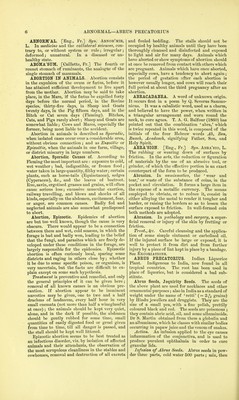
![ABSORBED' (-sorbd'). Syn. Chilled; Absoebe, Fr. In painting, a term among French con- noisseurs, to represent that state of a picture in which the oil has sunk into the canvas or ground, leaving the colours ' flat/ and the touches indis- tinct. The remedy consists in rubbing the sur- face of the picture, previously well cleaned, with a soft sponge dipped in a little drying oil, and after some days varnishing it; when it should be kept in a warm room until perfectly dry. ABSORB'ENT. Syn. Absoeb'ens, L. ; Ab- SOEBANT, Fr.; Absoebieend, Ger. Imbibing; that imbibes or sucks up; variously applied in science and art. (See below.) Absorbent Ground. In painting, a picture- ground prepared wholly or chiefly in distemper or water colour, in order that the redundant oil in the colours subsequently applied may be imme- diately ' absorbed/ by which expedition is per- mitted, and brilliancy imparted to them. Absorbent Powders. Fine powders used lo- cally for drying purposes or to allay irritation, sometimes to hide unsightly patches, as in skin diseases, or to give an artificial softness to the skin in form of toilet powder. The most useful absorbents are kaolin, Fuller's earth, French chalk, starch, oxide of zinc, calamina, oxychloride of bismuth, and oat flour. Mixtures of these are perfumed and sold under fancy names. A drying powder much used in hospitals is a mixture of 1 part zinc oxide and 2 parts starch powder. Absorbent Surfaces. In the arts, these are usually rendered non-absorbent, preliminary to their being bronzed, gilded, painted, or varnished, by giving them one, or more, coats of thin size, so as to destroy their porosity; care being taken to allow each coat to become thoroughly dry before the application of the next one; and also, finally, to remove any unabsorbed excess of size from the surface, by means of a sponge dipped in warm water. This applies to alabastee, PAPEE, WOOD, PLASTEE CASTS, &C ; and to WALLS and ceilings which are not exposed to the weather, and which there is not time to prepare with dry- ing oil. See Beonzing, Maps, Vaenishing, &c. Absorption and consequent adherence in porous moulds, as those of plaster, are usually prevented by thoroughly saturating the pores of the mould with melted tallow, or a mixture of tallow and bees' wax; or for delicate objects or the electro- type, with white wax. The 'dry moulds' are either heated before the application of these sub- stances, or they are boiled in them; any portion that may finally remain unabsorbed being care- fully removed with cotton-wool or a soft rag. Another method is to wash the moulds over two or three times with drying oil, or to boil them in in it; after which they must be exposed to the air for some days, to dry and harden. Before being used for plaster, composition, &c, the sur- face of these prepared moulds require to be slightly moistened with sweet oil. Plaster moulds are generally prepared for sul- phur, wax, and gutta-percha casts, by simply placing them (upright) with the back immersed in a little water, contained in any shallow vessel, as a saucer or plate; and letting them remain there until moisture begins to appear on the surface. The materials to be cast, or moulded, should then be used at the lowest possible tem- perature, to prevent the formation of air-bubbles. The adherence of wax, or mixtures containing it, and of gutta percha, is best prevented by moistening the surface of the mould (whether of plaster, metal, or gutta percha), immediately before use, with soft soap reduced to the consist- ence of thin cream with water. See Casts, Moulds, Electeotype, &c. ABSORBENTS. The lymphatic or absorbent vessels, so called from their reputed function, are distinct from the blood-vessels and arise in almost every part of the body, ultimately entering the great veins of the neck. The majority previously oin into a main trunk, the thoracic duct, which lies in front of the vertebra?, and opens into the veins of the left side at the angle of junction of the subclavian and internal jugular veins. The absorbents of the alimentary canal during diges- tion carry a milky opaque fluid, the chyle, which they absorb from the food, hence their special name lacteals. Absorbents. In botany and vegetable physiology, the origins of the different vessels constituting the vascular tissue, as they are found in the root, where they imbibe or suck up the nutritive fluids from the soil. See Plants and Vegetables. Absorbents. In agriculture and chemistry, substances which possess the power of withdraw- ing moisture from the atmosphere; as soils, cal- cium chloride, strong sulphuric acid, argillaceous earths, &c. Also (but less frequently) substances which neutralise acids; as chalk, lime, and magnesia. Absorbents differ from ' deliquescent salts'; the latter attract moisture and dissolve in it; whilst the former merely suck it into their pores, as a sponge does water. See Absoeption. Absorbents. Syn. Absoeben'tia, L. In medicine and pharmacy, substances which remove acidity from the stomach and bowels. Of these the principal are—magnesia, carbonate and bi- corbonate of magnesia, prepared chalk, and the carbonates and bicarbonates of potash, soda, and ammonia. The first four are popularly called earthy absorbents; and the others, alkaline ab- sorbents. See Antacids. Absorbents. In surgery, cotton deprived of its oil, lint, tow, wood wool, moss, and peat. The following absorbent mixtures aretakenfrom Dr Kirby's valuable work, ' Selected Remedies': 1. Infusion of rhubarb, 1^ oz.; compound spirit of ammonia, 1| dr.; compound infusion of gentian to 6 oz. Two tablespoonfuls to be taken 3 times a day. 2. Bicarbonate of potash, 1^ dr.; syrup, 2 dr.; compound spirit of ammonia, 1^ dr.; compound infusion of gentian to 6 oz. Two tablespoonfuls to be taken 3 times a day. 3. Bicarbonate of soda, 1| dr.; spirits of chloro- form, 1^ dr.; infusion of calumba to 6 oz. Two tablespoonfuls to be taken 3 times a day. ABSORPTION. [Eng., Fr.] Syn. Absoep'tio, L.; Einsaugung, Ger. The act or the power of absorbing, in various applications. (See below.) Absorption. In agriculture, the power pos- sessed by soils of absorbing moisture from the atmosphere. The more a soil is divided by labour and vegetation, the greater is its absorbent power, and, consequently, its fertility. Indeed, the latter](https://iiif.wellcomecollection.org/image/b20416064_001_0024.jp2/full/800%2C/0/default.jpg)