A companion to the United States Pharmacopoeia : being a commentary on the latest edition of the pharmacopoeia and containing the descriptions, properties, uses, and doses of all official and numerous unofficial drugs and preparations in current use in the United States, together with practical hints, working formulas, etc., designed as a ready reference book for pharmacists, physicians, and students : with over 650 original illustrations / by Oscar Oldberg and Otto A. Wall.
- Oscar Oldberg
- Date:
- 1887
Licence: Public Domain Mark
Credit: A companion to the United States Pharmacopoeia : being a commentary on the latest edition of the pharmacopoeia and containing the descriptions, properties, uses, and doses of all official and numerous unofficial drugs and preparations in current use in the United States, together with practical hints, working formulas, etc., designed as a ready reference book for pharmacists, physicians, and students : with over 650 original illustrations / by Oscar Oldberg and Otto A. Wall. Source: Wellcome Collection.
Provider: This material has been provided by the Francis A. Countway Library of Medicine, through the Medical Heritage Library. The original may be consulted at the Francis A. Countway Library of Medicine, Harvard Medical School.
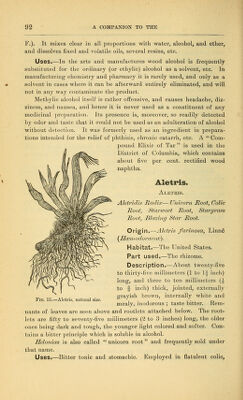
![F.). It mixes clear in all proportions with water, alcohol, and ether, and dissolves fixed and volatile oils, several resins, etc. Uses.—In the arts and manufactures wood alcohol is frequently substituted for the ordinary (or ethylic) alcohol as a solvent, etc. In manufacturing chemistry and pharmacy it is rarely used, and only as a solvent in cases where it can be afterward entirely eliminated, and will not in any way contaminate the product. Methylic alcohol itself is rather offensive, and causes headache, diz- ziness, and nausea, and hence it is never used as a constituent of any medicinal preparation. Its presence is, moreover, so readily detected by odor and taste that it could not be used as an adulteration of alcohol without detection. It was formerly used as an ingredient in prepara- tions intended for the relief of phthisis, chronic catarrh, etc. A Com- pound Elixir of Tar is used in the District of Columbia, which contains about five per cent, rectified wood naphtha. Aletris. Aleteis. Aletridis Radix— Unicorn Root, Colic Moot, Starwort Moot, Stargf7'ass Moot, JBlazing Star Moot. Origin.—Aletris farinosa, Linn6 {Ilcemodoracece). Habitat.—The United States. Part used.—The rhizome. Description.—About twenty-five to thirty-five millimeters (1 to ]|- inch) long, and three to ten millimeters (^ to § inch) thick, jointed, externally grayish brown, internally white and mealy, inodorous ; taste bitter. Rem- nants of leaves are seen above and rootlets attached below. The root- lets are fifty to seventy-five millimeters (2 to 3 inches) long, the older ones being dark and tough, the younger light colored and softer. Con- tains a bitter principle which is soluble in alcohol. Helonias is also called unicorn root and frequently sold under that name. Uses.—Bitter tonic and stomachic. Employed in flatulent colic. Fig. 13.—Aletris, natural size.](https://iiif.wellcomecollection.org/image/b21070866_0106.jp2/full/800%2C/0/default.jpg)