The syllabus of physical exercises for schools 1909.
- Great Britain. Ministry of Education
- Date:
- 1911
Licence: In copyright
Credit: The syllabus of physical exercises for schools 1909. Source: Wellcome Collection.
Provider: This material has been provided by UCL Library Services. The original may be consulted at UCL (University College London)
84/184 page 72
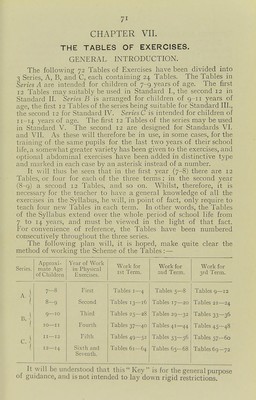
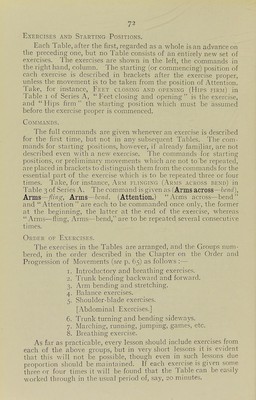
![Exercises and Starting Positions. Each Table, after the first, regarded as a whole is an advance on the preceding one, but no Table consists of an entirely new set of exercises. The exercises are shown in the left, the commands in the right hand, column. The starting (or commencing) position of each exercise is described in brackets after the exercise proper, unless the movement is to be taken from the position of Attention. Take, for instance, Feet closing and opening (Hips firm) in Table i of Series A, Feet closing and opening is the exercise, and Hips firm the starting position which must be assumed before the exercise proper is commenced. Commands. The full commands are given whenever an exercise is described for the first time, but not in any subsequent Tables. The com- mands for starting positions, however, if already familiar, are not described even with a new exercise. 1 he commands for starting positions, or preliminary movements which are not to be repeated, are placed in brackets to distinguish them from the commands for the essential part of the exercise which is to be repeated three or four times. Take, for instance, Arm flinging (Arms across bend) in Table 3 of Series A. The command is given as (Arms across—fcenc/). Arms—fling. Arms—bend. (Attention.) Arms across—bend and Attention are each to be commanded once only, the former at the beginning, the latter at the end of the exercise, whereas Arms—fling, Arms—bend, are to be repeated several consecutive times. Order of Exercises. The exercises in the Tables are arranged, and the Groups num- bered, in the order described in the Chapter on the Order and Progression of Movements {see p. 65) as follows :— 1. Introductory and breathing exercises. 2. Trunk bending backward and forward. 3. Arm bending and stretching. 4. Balance exercises. 5. Shoulder-blade exerciseSo [Abdominal Exercises.] 6. Trunk turning and bending sideways. 7. Marching, running, jumping, games, etc. 8. Breathing exercise. As far as practicable, every lesson should include exercises from each of the above groups, but in very short lessons it is evident that this will not be possible, though even in such lessons due proportion should be maintained. If each exercise is given some three or four times it will be found that the Table can be easily worked through in the usual period of, say, 20 minutes.](https://iiif.wellcomecollection.org/image/b21291056_0084.jp2/full/800%2C/0/default.jpg)