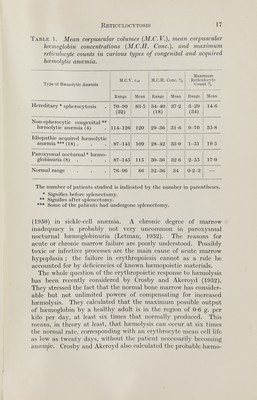
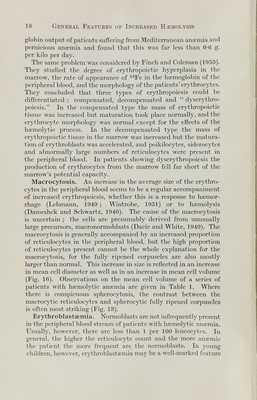
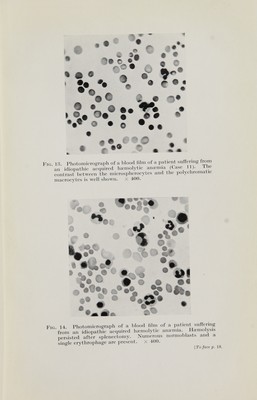
The haemolytic anaemias, congenital and acquired / by J.V. Dacie.
- John Vivian Dacie
- Date:
- 1954
Licence: Attribution-NonCommercial-NoDerivatives 4.0 International (CC BY-NC-ND 4.0)
Credit: The haemolytic anaemias, congenital and acquired / by J.V. Dacie. Source: Wellcome Collection.
41/580 (page 19)
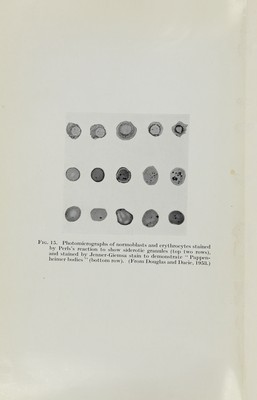
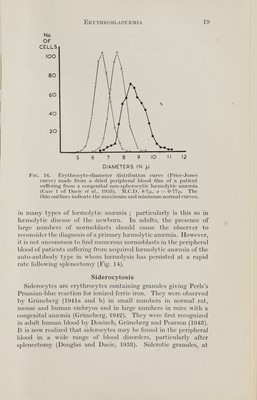
![EllYTKROBLAST.î::\nA 19 No. OF DIAMETERS IN Fig. IG. Erythrocyte-diameter distribution curve (Price-Jones curve) made from a dried peripheral blood film of a patient suffering from a congenital non-spherocytic hiemolytic anaemia (Case 1 of Dacie et al, ]9Г).3). M.C.I). 8-7^, ст = 0-77/х. The thin outlines indicate the maximum and minimum normal curves. in many types of haemolytic anaemia ; particularly is this so in hscmolytic disease of the пелуЬогп. In adults, the presence of large numbers of normoblasts should cause the observer to reconsider the diagnosis of a primary haemolytic anœmia. However, it is not uncommon to find numerous normoblasts in the peripheral blood of patients suffering from acquired hocmolytic anoemia of the auto-antibody type in whom hiemolysis has persisted at a rapid rate following splenectomy (Fig. 14). Siderocytosis Siderocytcs are erythrocytes containing granules giving Perls's Prussian-blue reaction for ionized ferric iron. They were observed by Grüneberg (1941a and b) in small numbers in normal rat, mouse and human embryos and in large numbers in mice with a congenital anœmia (Grüneberg, 1942). They were first recognized in adult human blood by Doniach, Grüneberg and Pearson (1943). It is ПОЛУ realized that siderocytcs may be found in the peripheral blood in a Avide range of blood disorders, particularly after splenectomy (Douglas and Dacie, 1953). Siderotic granules, at](https://iiif.wellcomecollection.org/image/b18021463_0042.JP2/full/800%2C/0/default.jpg)