Volume 1
Handbook of American Indian languages / by Franz Boas ; with illustrative sketches by Roland B. Dixon ... [and others].
- Franz Boas
- Date:
- 1911-
Licence: Attribution-NonCommercial 4.0 International (CC BY-NC 4.0)
Credit: Handbook of American Indian languages / by Franz Boas ; with illustrative sketches by Roland B. Dixon ... [and others]. Source: Wellcome Collection.
1010/1088 (page 998)
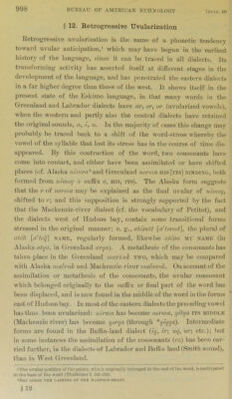
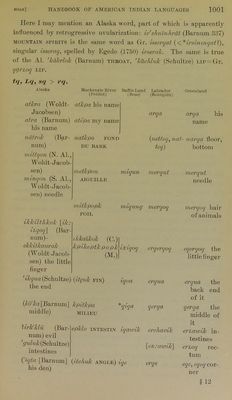
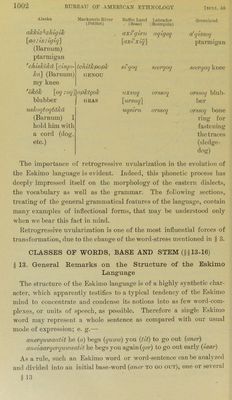
![[bli.l. 40 § 12. Retrogressive Uvularization Retrogressive uvularization is the name of a phonetic tendency toward uvular anticipation,* which may have begun in the earliest history of the language, since it can be traced in all dialects. Its transforming activity has asserted itself at different stages in the development of the language, and has penetrated the eastern dialects in a far higher degree than those of the west. It shows itself in (he present state of the Eskimo language, in that many words in the Greenland and Labrador dialects have a?', er, or (uvuilarized vowels), when the western and partly also the central dialects have retained the original sounds, u, i, u. In the majority of cases this change ma}^ probably be traced back to a shift of the word-stress whereby the vowel of the s3dlablc that lost its stress has in the course of time dis- appeared. By this contraction of the word, two consonants have come into contact, and either have been assimilated or have shifted places (cf. Alaska vimra'^ and Greenland nerma ms [its] binding, both formed from nlmeq -f- suffix a, his, its). The Alaska form suggests that the r of nenna may be explained as the tinal uvular of nimeq^ shifted to r\ and this supposition is strongl}^ supported b} the fact that the Mackenzie-river dialect (cf. the vocabulary of I’etitot), and the dialects west of Hudson bay, contain some transitional forms stressed in the original manner; e. g., atepeit {a'tereet\ the plural of afen [a'teq^ name, regularly formed, likewise atepa my name (in Alaska in Greenland arqa). A metathesis of the consonants has tidcen place in the Greenland marnik two, which may be compared M’ith Alaska malruk and Mackenzie-river malmrok. On account of the assimilation or metathesis of the consonants, the uvular consonant which belonged originally to the suffix or final part of the word has been displaced, and is now found in the middle of the word in the forms east of Hudson bay. In most of the eastern dialects the preceding vowel has thus been uvularized: nh'via has become nerma^ qitqa its middle (Mackenzie river) has become qei'qa (through *qlqqa). Intermediate forms are found in the Baffin-land dialect {iq^ ir\ uq^ ur\ etc.); but in some instances the assimilation of the consonants (jn) has been car- ried further, in the dialects of Labrador and Baffin land (Smith sound), than in West Greenland. ■The uvular position of the palate, which originally belonged to the end of the word, is anticipated in the base of the word (Thalbllzer I, 241-242). «Ray ntmja the lashing of the hakpoon-shakt. §12](https://iiif.wellcomecollection.org/image/b24881831_0001_1010.jp2/full/800%2C/0/default.jpg)