Volume 1
Handbook of American Indian languages / by Franz Boas ; with illustrative sketches by Roland B. Dixon ... [and others].
- Franz Boas
- Date:
- 1911-
Licence: Attribution-NonCommercial 4.0 International (CC BY-NC 4.0)
Credit: Handbook of American Indian languages / by Franz Boas ; with illustrative sketches by Roland B. Dixon ... [and others]. Source: Wellcome Collection.
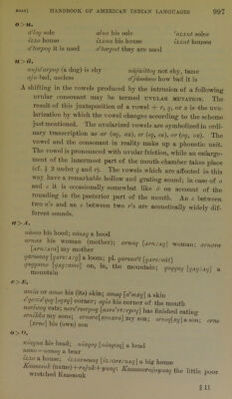
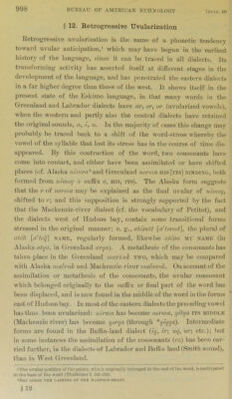
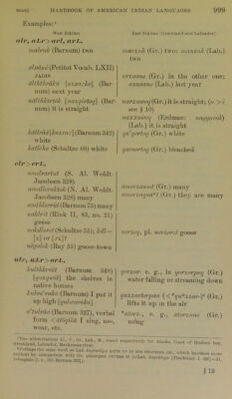
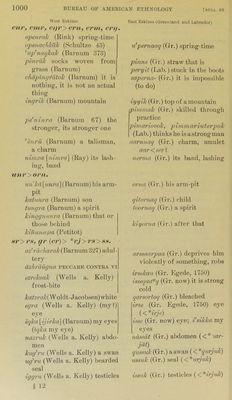
1014/1088 (page 1002)
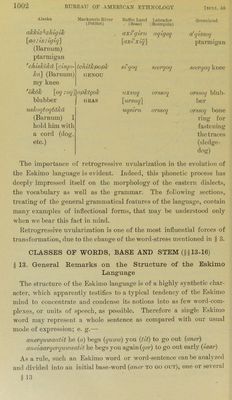
![BUREAU OP A MEET CAN ETHNOLOGY rnuu-. 40 Alaska Mackenzie River BaiTin Land Labrador Greenland (Petitot) (Boa-s) (Bourqiiin) ahhiz^zliigih , axi'girn (tqigeq a'qisseq \an: is rig iq\ \c(ld'xiq\ ptarmigan (Barnum) ptarmigan 'chisTcolid {cisqo- tchitlcpopl'. si'qoq seerqoq seerqoq knee /■«] (Barnum) GENOU my knee 'okdh \oq:0(1^0phtgoh ■uxsuq orssoq orsxoq blub- blubber [ GRAS \ursuq\ ber usJcoqtoqtdJid uqsirn orsseq orsseq bone (Barnum) 1 ring for hold him with fastening a cord (dog, thetraces etc.) (sledge- • ' dog) The importance of retrogressive uvularization in the evolution of the Eskimo language is evident. Indeed, this phonetic process has deeply impressed itself on the morphology of the eastern dialects, the vocabulary as well as the grammar. The following sections, treating of the general grammatical features of the language, contain many examples of inflectional forms, that may be understood only when we bear this fact in mind. Retrogressive uvularization is one of the most influential forces of transformation, due to the change of the word-stress mentioned in § 3. CLASSES OF WORDS, BASE AND STEM (§§13-16) § 13. General Remarks on the Structure of the Eskimo Language The structure of the Eskimo language is of a highly synthetic char- acter, which apparently testifies to a typical tendencj' of the Eskimo mind to concentrate and condense its notions into as few word-com- plexes, or units of speech, as possible. Therefore a single Eskimo word maj’^ represent a whole sentence as compared with our usual mode of expression; e. g.— anerquwaatit he (a) begs {quwd) you {tit) to go out {aner) aneiaarqerqxnoaaiit he begs you again {qer) to go out early {iaar) As a rule, such an Eskimo word or word-sentence can be analyzed and divided into an initial base-word {anen' to go out), one or several § 13](https://iiif.wellcomecollection.org/image/b24881831_0001_1014.jp2/full/800%2C/0/default.jpg)