Volume 1
Handbook of American Indian languages / by Franz Boas ; with illustrative sketches by Roland B. Dixon ... [and others].
- Franz Boas
- Date:
- 1911-
Licence: Attribution-NonCommercial 4.0 International (CC BY-NC 4.0)
Credit: Handbook of American Indian languages / by Franz Boas ; with illustrative sketches by Roland B. Dixon ... [and others]. Source: Wellcome Collection.
1035/1088 (page 1023)
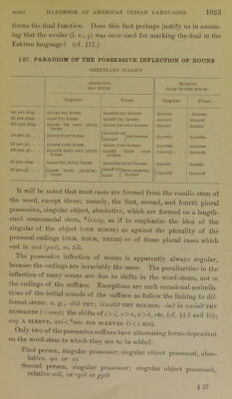
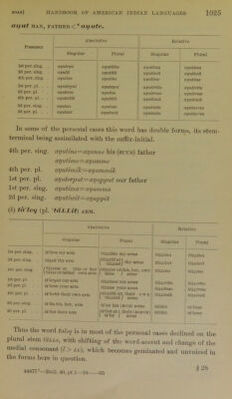
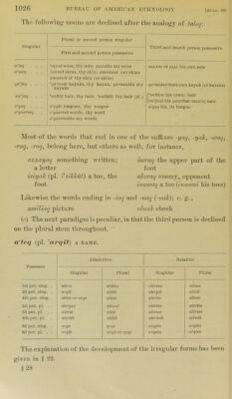
![forms the dual function. Does this fact perhaps justify us in assum- ing that the uvular (i. e., q) was once used for marking the dual in the Eskimo language? (cf. §17.) §27. PABADIGM OF THE POSSESSIVE INFLECTION OF NOUNS GREENLAND DIALECT Absolutive Relative ihhO HOUSE i'LLUp OF THE HOUSE Singular Plural Singular Plural 1st per. sing. . iLLopa my house iLLukka my houses iLLuma iLLuma 2(1 per. sing. . iLLut thy house iLLutit thy bouses iLLu wit ULuunt 4th per. sing. . iLLitne his own (suus) iLLunc his own houses iLLume iLLume 1st per. pi. . . iLLorput our house [iLLUU'ut or) ]. , our houses [iLLoput J iLLu.«!lta iLLuxlla 2d per. pi. . . iLLorse your house iLLuse your houses iLLiiviQse ILLUWSSe 4thper.pl. . . iiLortik their own (subs) house iLLutik their own houses iLLumik • iLLumik 3d per. sing. . iLLua his (ejus) house iiiue his (ejus) houses ihLuata iLLuiea 3dper.pl. . . nlLuat their (eokum) 1 house liLLuit or) (ijgir (eorum) [iLLue 1 houses jiUMnni- iLLumik It will be noted that most cases are formed from the vocalic stem of the word, except three; namely, the first, second, and fourth plural possessive, singular object, absolutive, which are formed on a length- ened consonantal stem, *iLLoq, as if to emphasize the idea of the singular of the object (one house) as against the plurality of the personal endings (our, your, their) or of those plural cases which end in wut {put), se, The possessive inflection of nouns is apparently always regular, because the endings are invariably the same. The peculiarities in the inflection of many nouns are due to shifts in the word-stems, not in the endings of the suffixes. Exceptions are such occasional assimila- tions of the initial sounds of the suffixes as follow the linking to dif- feient stems, e. g., -itit thi ; ihLutit thy houses; -isit in uwisit thy HUSBANDS {<uwe)-, the shifts oie>i, o>ii,a>d, etc. (cf. §§ 6 and 10); aaq A SLEEVE, aai<.*aae his sleeves (»<<?his). Only two of the possessive suffixes have alternating forms dependent on the word-stem to which they are to be added: First person, singular possessor; singular object possessed, abso- lutive, ya or ra Second person, singular possessor; singular object possessed relative wit, or rpit ox pjyit ' §27](https://iiif.wellcomecollection.org/image/b24881831_0001_1035.jp2/full/800%2C/0/default.jpg)