Volume 1
Handbook of American Indian languages / by Franz Boas ; with illustrative sketches by Roland B. Dixon ... [and others].
- Franz Boas
- Date:
- 1911-
Licence: Attribution-NonCommercial 4.0 International (CC BY-NC 4.0)
Credit: Handbook of American Indian languages / by Franz Boas ; with illustrative sketches by Roland B. Dixon ... [and others]. Source: Wellcome Collection.
1074/1088 (page 1062)
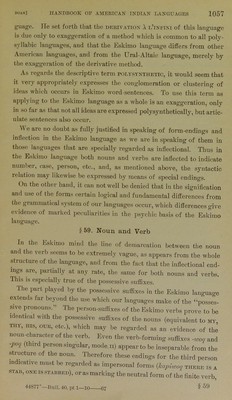
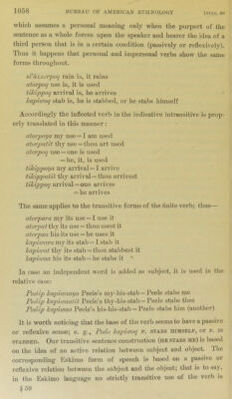
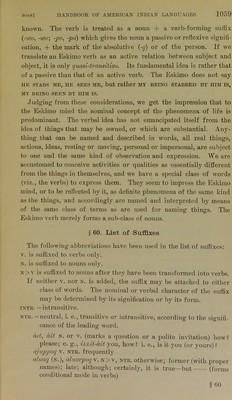
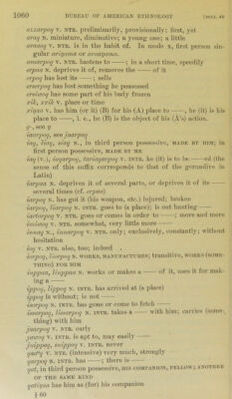
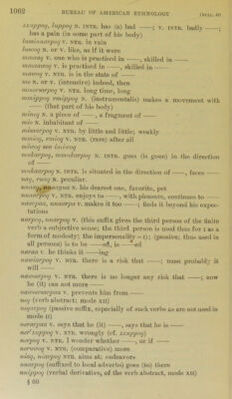
![I BULL. 40 LUippoq, luppoq N. iNTR. hii.s (a) bad ; V. INTH. ])adly • has a pain (in some part of his t)od30 ' ’ lussinnarpoq\. ntr. in vain Imooq N. or V. like, as if it were mmuaq v. one who is practised in , skilled in mmaawoq v, is pra(;tised in , skilled in mawoq v. ntr. is in the state of ms N. or V. (intensive) indeed, then mmersorpoq v. ntr. long time, long m.mipq)oq Tmippoq n. (instrumentalis) makes a movement with (that part of his bodv') mineq N. a piece of , a fragment of 7nio N. inhabitant of misaarpoq v. ntr. b,y little and little; weaklv mmioq, rmioq v. ntr. (rare) after all miwoq see imiu'oq muJcaypoq, mmukarpoq n. intr. goes (is gone) in the direction of mukaarpoq 'S. intr. is situated in the direction of , faces naq, rnaq N. peculiar. nniuup nnamjusb N. his dearest one, favorite, pet nnaarpoq v. ntr. enjo3'S to , with pleasure, continues to naarpaa, nnaarpa v. makes it too ; finds it beyond his expec- tations narpoq^ nnarpoq v. (this suffix gives the third per.son of the finite verb a subjective sense; the third person is used thus for i as a form of modesty; the impersonality = i); (passive; thus used in all persons) is to be ed, is —^ed naraa v. he thinks it ing nawiarpoq v. ntr. there is a risk that ; most probably it will naweerqioq v. ntr. there is no longer any risk that ; now he (it) can not more naweet'sarpaa v. prevents him from neq (verb abstract; mode xii) neqarpoq (passive suffix, especiall3' of such verbs as are not used in mode ii) nerarpaa v. says that he (it) , says that he is ner'Luppoq v. ntr. wrongl3^ (cf. LLuppoq) nerpoq v. ntr. I wonder whether , or if nei'uxooq v. ntr. (comparative) more niaq^ niaipoq ntr. aims at; endeavors nnarpoq (suffixed to local adverbs) goes (to) there nnippoq (verbal derivative, of the verl) abstract, mode xii) §60](https://iiif.wellcomecollection.org/image/b24881831_0001_1074.jp2/full/800%2C/0/default.jpg)