Volume 1
Handbook of American Indian languages / by Franz Boas ; with illustrative sketches by Roland B. Dixon ... [and others].
- Franz Boas
- Date:
- 1911-
Licence: Attribution-NonCommercial 4.0 International (CC BY-NC 4.0)
Credit: Handbook of American Indian languages / by Franz Boas ; with illustrative sketches by Roland B. Dixon ... [and others]. Source: Wellcome Collection.
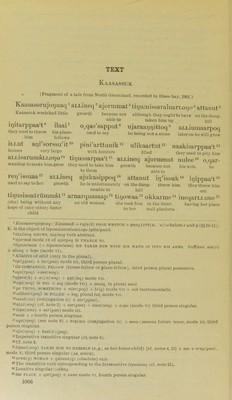
1078/1088 (page 1066)
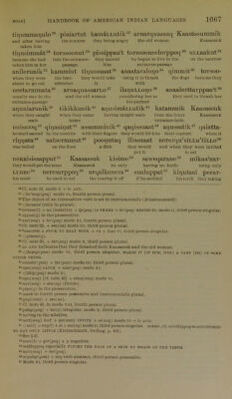
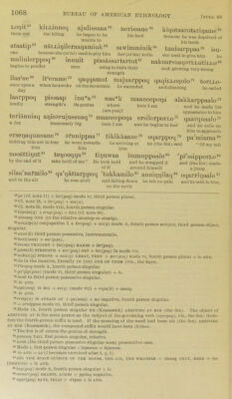
![TEXT Kaasassuk * (Fragment of a tale from North Greenland, recorded in Disco bay, 1901.) Kaasiisorujoijuaq 1 siLLiiieq 2 ajoruiniatHiijumissaraluarLoijo^ attaruit® Kaasasuk wretched little growth because not although they ought to have onthedung- able to taken him up hill o^qassapput® ujaraaijijittoq” aLLiuinaarpoq used to .say he being not a slone lateronhe will grow pini arttuuik “ iilikaai'tut^^ naaki.sarppaa't , ^ with hunters filled they used to pity him aLLi,saruinai.Loijo“ tiiju.s.'iarpaa't*® aLurieq ajormmat nulee*® o,qar- wanting to make him grow they used to take him growth because not his wife he to them able to Feij'issuaa*^ aLLineq ajukasippoq‘« attanut iij'issuk*® iijippaa‘t=“ used to say to her growth he is unfortunately onthedung- throw him they threw him unable to hill out tiijusissaaruiuiiiat^' arnarquasaap^^ tiijowaa==* okkarme^* ineqai’LLune (she) being without any an old woman she took him in the front- having her place hope of (any other; foster to her wall platform child ' Kaasasonijovuaq< Kaasasuk + ruju{k) poor wretcui -p yHaq little. u>u before r and v (§§ 10-11). K. is the object of liyumissaraluarLo^o iyilarpaait. ^aiLiunui GROWS, aLLineq verb abstract. *ojormat mode i.x of ajorpoq is unable to. ^ *tiguniiwaa (= liyum.miwaa) he takes him with his ha.vo or into his arms. Suffixes; gsa(r) -1- aluaq -p logo (mode vi). ^ Allative of altiil (only in the plural). ‘igiippaa) -p tar(paa) mode in, third per.son plural. t i7a COMPANION, fellow (house-fellow or place-felloiv), third person plural possessive. *oqa(rpoq) +ssa(woq). >ujara(,k) -p a<iu{'woq) -p ggi(laq) mode vii. ■ >'>agi( woq) is big -P soq (mode vii) -p ssuaq, in plural ssuil. Upe thing, something -P niar{poq) -P to(q) mode vii -P nik instrumentalis. '^uUkaar(poq) is filled -p toq, plural tut, mode vii. >^naak(aa) (conjugation li) +sar(ppaa). '^aLLi(woq) (cf. note 2) -p sar(paa) -p uma{woq) -p Lugo (mode vi) third person singular. '<‘tigu(waa) -p sar(paa) mode III. *»nufe -p e fourth person singular. oqa{rpoq) (see note 8) + Feg{aa) (conjugation ii) -p ssua<^asawaa future tense, mode iii, third person singular. >^ajo{rpoq) + kasHk){poq). •^Imperative transitive singular (cf.note 6). “Cf. note 6. ^tigusi(,woq) takes him to herself (e.g., as her foster-child) [cf. notes 4,15] -P ssa -P ei-«p(j«ia), mode X, third person singular (as, since). ^ama{q) woman -t- quaaaa{q) (obsolete) old. “The transitive verb corresponding to the intran.sitive tigusiwoq (cf. note 21). Locative singular<ol-ta(p ^ine PLACE -p qar(poq) -p Lune mode vi, fourth person singular. 106G iijitiirppaa'f’ ilaai^ they used to throw his place- him fellows iLLut aiji'sorssu'it*® houses very large](https://iiif.wellcomecollection.org/image/b24881831_0001_1078.jp2/full/800%2C/0/default.jpg)